New Image Could Help Identify Man Found Dead in Chiswick
Body of 'Barnes Bridge Man' discovered 43 years ago
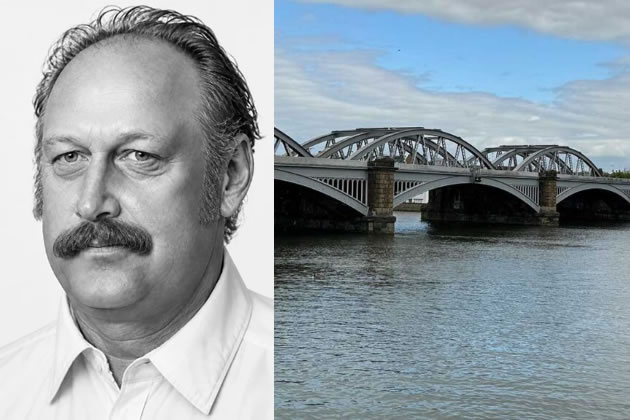
Left: The new image of the dead man. Picture: Hew Merriman. Right: Barnes Bridge
|
September 12, 2026
A man found dead on the banks of the Thames at Chiswick more than forty years ago could finally be identified after a new forensic reconstruction of his face was released.
The man, long known only as “Barnes Bridge Man,” was discovered on the north shore of the river near Barnes Bridge on 6 September 1983. Despite decades of enquiries, his identity has never been established.
Locate International, a UK cold-case charity, has now issued a fresh appeal featuring a “living depiction” created by forensic artist Hew Morrison. Working from the original autopsy photograph and sketches, Morrison used advanced digital techniques to reconstruct how the man would likely have looked in life, adjusting for post-mortem changes, poor lighting and the grainy black-and-white film used at the time.
The man is believed to have been around 35 years old, with blue eyes, ginger hair, long sideburns, a stocky build and a height of approximately 5ft 5in. A post-mortem examination recorded blunt force trauma and abrasions to both hands, suggesting he may have been involved in an altercation shortly before entering the water. The coroner returned an open verdict.
Locate International’s investigators believe he was only in the river for a short time before being washed downstream to the spot where he was found. A dedicated team has reviewed all available evidence shared by UK policing, hoping that renewed attention — and a more lifelike image — might finally prompt recognition.
Dr Mark Greenhalgh, CEO of Locate, said the new depiction offers the strongest chance yet of identifying him. “This striking new image and the detailed work of our investigation team provides a real opportunity for someone to put a name to Barnes Bridge Man after almost 43 years. Someone out there, an old friend, workmate or distant family member could see this forensic reconstruction and help us bring closure to this cold case.”
Few personal possessions were recorded in the original National Crime Agency file, but several items of jewellery have drawn investigators’ attention. Among them was a Claddagh pendant — a traditional Irish symbol of love, friendship and loyalty — which was especially popular among Irish men from the Traveller community during the 1980s. A Telstar watch, widely sold in Ireland in the 1970s and 1980s, was also found on the body. These clues have led Locate to explore potential links to the London Irish or Irish Traveller communities.
Morrison described the painstaking process behind the reconstruction, explaining that numerous stock facial images were used to build the head and individual features. Each element was then digitally modified, drawn and painted to match the man’s known characteristics before being blended into a single lifelike portrait.
Locate International hopes the new depiction will jog memories among anyone who may have known the man — whether as a colleague, neighbour, friend or distant relative.
Value Reading Articles Like This? Help Us Produce More This site remains committed to providing local community news and public interest journalism. Articles such as the one above are integral to what we do. We aim to feature as much as possible on local societies, charities based in the area, fundraising efforts by residents, community-based initiatives and even helping people find missing pets. We've always done that and won't be changing, in fact we'd like to do more. However, the readership that these stories generates is often below that needed to cover the cost of producing them. Our financial resources are limited and the local media environment is intensely competitive so there is a constraint on what we can do. We are therefore asking our readers to consider offering financial support to these efforts. Any money given will help support community and public interest news and the expansion of our coverage in this area. A suggested monthly payment is £8 but we would be grateful for any amount for instance if you think this site offers the equivalent value of a subscription to a daily printed newspaper you may wish to consider £20 per month. If neither of these amounts is suitable for you then contact info@neighbournet.com and we can set up an alternative. All payments are made through a secure web site. One-off donations are also appreciated. Choose The Amount You Wish To Contribute. If you do support us in this way we'd be interested to hear what kind of articles you would like to see more of on the site – send your suggestions to the editor. For businesses we offer the chance to be a corporate sponsor of community content on the site. For £30 plus VAT per month you will be the designated sponsor of at least one article a month with your logo appearing if supplied. If there is a specific community group or initiative you'd like to support we can make sure your sponsorship is featured on related content for a one off payment of £50 plus VAT. All payments are made through a secure web site. |