GLA Opts Not to Intervene in Burlington Lane Scheme
Blow for campaigners as Deputy Mayor rubber stamps council approval
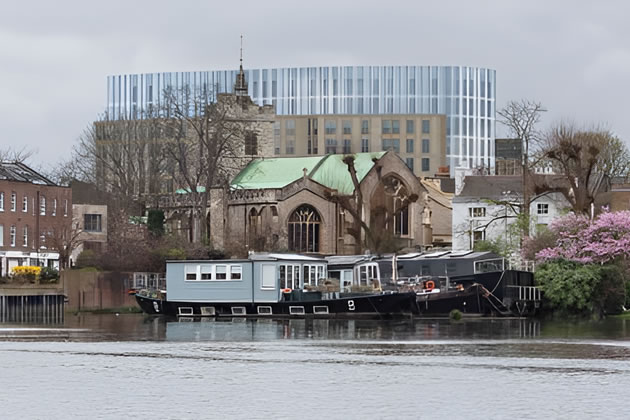
A visualisation from planning documents of how the building would look behind St. Nicholas Church
November 6, 2025
Dashing the hopes of local campaigners, the Greater London Authority has told Hounslow Council it will not call in the planning application for the ten-storey building at 1 Burlington Lane.
In a letter to the council dated this Monday (3 November) , Deputy Mayor Jules Pipe confirmed the GLA had considered the case (GLA ref: 2024/0508/S2) and the environmental information submitted so far, and was “content to allow the local planning authority to determine the case itself, subject to any action that the Secretary of State may take.” The letter follows the council’s notification on 23 October that it was minded to approve the application.
The GLA’s non-intervention removes the prospect of an immediate London-level hold or redesign requirement, but it does not prevent further challenges. The Secretary of State retains the statutory power to call in the application on planning-policy grounds although it is currently thought unlikely this will happen.
Hounslow Council’s planning committee approved the controversial project that looks sets to replace the existing vacant office building with a residential-led mixed -use scheme. The approved plans propose the demolition of the current structure and the construction of a part -six, part -ten -storey building delivering 132 self -contained flats alongside a terrace of three -storey houses, with flexible commercial floorspace at ground level and associated parking, amenity space and landscaping.
The applicant has presented the scheme as a local regeneration project intended to provide new housing and to refresh the building’s frontage to the Hogarth Roundabout.
Opponents, including the Old Chiswick Protection Society, were galvanised by what they believed was the unacceptably low level of affordable housing in the scheme and the impact the taller building would have on historic vistas across the oldest part of Chiswick. Council planners determined that this represented less than substantial harm which was outweighed by the new housing.
Like Reading Articles Like This? Help Us Produce More This site remains committed to providing local community news and public interest journalism. Articles such as the one above are integral to what we do. We aim to feature as much as possible on local societies, charities based in the area, fundraising efforts by residents, community-based initiatives and even helping people find missing pets. We’ve always done that and won’t be changing, in fact we’d like to do more. However, the readership that these stories generates is often below that needed to cover the cost of producing them. Our financial resources are limited and the local media environment is intensely competitive so there is a constraint on what we can do. We are therefore asking our readers to consider offering financial support to these efforts. Any money given will help support community and public interest news and the expansion of our coverage in this area. A suggested monthly payment is £8 but we would be grateful for any amount for instance if you think this site offers the equivalent value of a subscription to a daily printed newspaper you may wish to consider £20 per month. If neither of these amounts is suitable for you then contact info@neighbournet.com and we can set up an alternative. All payments are made through a secure web site. One-off donations are also appreciated. Choose The Amount You Wish To Contribute. If you do support us in this way we’d be interested to hear what kind of articles you would like to see more of on the site – send your suggestions to the editor. For businesses we offer the chance to be a corporate sponsor of community content on the site. For £30 plus VAT per month you will be the designated sponsor of at least one article a month with your logo appearing if supplied. If there is a specific community group or initiative you’d like to support we can make sure your sponsorship is featured on related content for a one off payment of £50 plus VAT. All payments are made through a secure web site. |