Massive Bollo Lane Project Officially Breaks Ground
Housing minister visits South Acton site to press go on construction
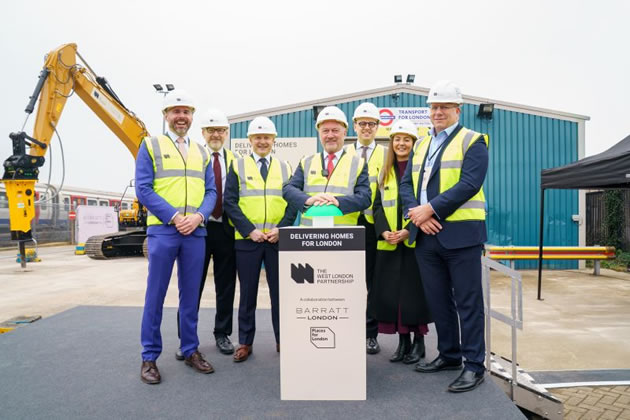
Housing Secretary Steve Reed (centre) presses a button to launch building work. Picture: Places for London
March 5, 2026
Construction has formally begun on the long-awaited Bollo Lane redevelopment in South Acton. Housing Secretary Steve Reed visiting the site this Wednesday (4 March) to mark the start of work.
The ceremony, in which the minister pressed down on a large green button to mark the start of construction, also launched the new West London Partnership between Places for London and Barratt London, the joint venture responsible for delivering the project. The scheme will eventually deliver around 900 new flats across a series of buildings running alongside the railway between Acton and Chiswick, with half of the units designated as affordable.
The Bollo Lane project has been several years in the making. Transport for London secured planning permission in 2021, but the scheme has faced delays linked to funding arrangements, the need to secure a development partner, and the wider slowdown in London’s construction sector.
Earlier reports suggested that the first phase would focus on the Chiswick end of the site, where the 25-storey building known as Brook House was expected to be the opening element of the scheme. However, the most recent construction industry updates indicate that the first phase now consists of a tranche of around 195 build-to-rent units in mid-rise blocks funded through an agreement with Grainger, forming part of the central plots (2D–2F). This phase, which has been dubbed Chiswick Reach, has detailed planning consent and Building Safety Regulator approval, allowing work to begin immediately.
The wider development will stretch along a long ribbon of land beside the railway, with a dozen buildings planned in total. Places for London describes Bollo Lane as set to become Europe’s largest Passivhaus-standard residential scheme, with new public spaces, shops, offices and improved pedestrian links between Acton and Chiswick. The partnership model is being promoted as a template for future development on public land, combining TfL’s landholdings with private-sector delivery capacity and support from Ealing Council and the Greater London Authority.
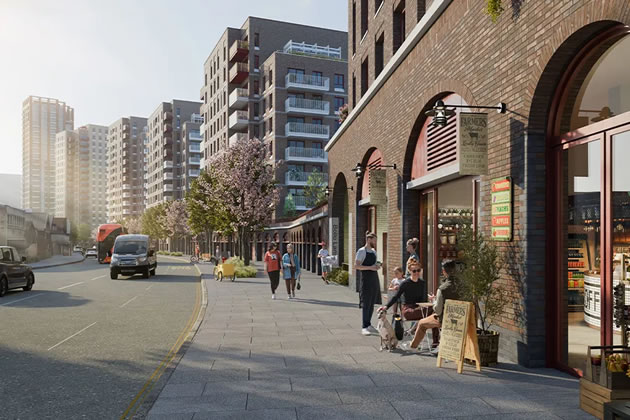
A visualisation of the scheme looking east along Bollo Road with Brook House at the far end. Picture: Places for London
The delays up to this point have been shaped by several factors. TfL’s financial position during and after the pandemic slowed the release of development sites, and the Bollo Lane scheme required a complex funding structure to be agreed before construction could begin. The Building Safety Regulator’s new gateway process has also lengthened pre-construction timelines for high-rise schemes across London. In addition, the project’s scale and its proximity to the railway required extensive technical work before the first phase could be approved.
With construction now underway, the partnership expects the project to progress in phases over several years.
Like Reading Articles Like This? Help Us Produce More This site remains committed to providing local community news and public interest journalism. Articles such as the one above are integral to what we do. We aim to feature as much as possible on local societies, charities based in the area, fundraising efforts by residents, community-based initiatives and even helping people find missing pets. We’ve always done that and won’t be changing, in fact we’d like to do more. However, the readership that these stories generates is often below that needed to cover the cost of producing them. Our financial resources are limited and the local media environment is intensely competitive so there is a constraint on what we can do. We are therefore asking our readers to consider offering financial support to these efforts. Any money given will help support community and public interest news and the expansion of our coverage in this area. A suggested monthly payment is £8 but we would be grateful for any amount for instance if you think this site offers the equivalent value of a subscription to a daily printed newspaper you may wish to consider £20 per month. If neither of these amounts is suitable for you then contact info@neighbournet.com and we can set up an alternative. All payments are made through a secure web site. One-off donations are also appreciated. Choose The Amount You Wish To Contribute. If you do support us in this way we’d be interested to hear what kind of articles you would like to see more of on the site – send your suggestions to the editor. For businesses we offer the chance to be a corporate sponsor of community content on the site. For £30 plus VAT per month you will be the designated sponsor of at least one article a month with your logo appearing if supplied. If there is a specific community group or initiative you’d like to support we can make sure your sponsorship is featured on related content for a one off payment of £50 plus VAT. All payments are made through a secure web site. |