Chiswick Councillors Call for Floating Bus Stop Review
TfL report concedes that some installations fall short of design standards
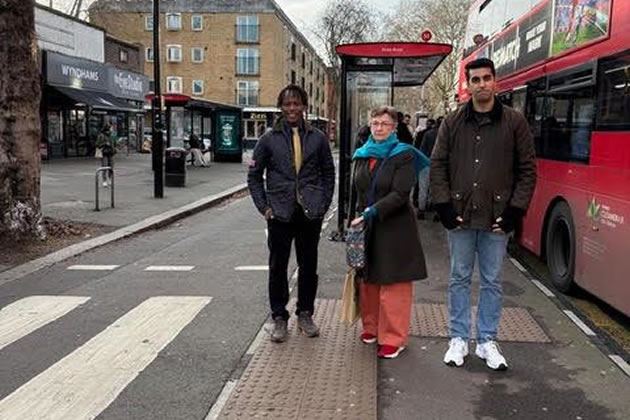
Cllrs Ron Mushiso, Joanna Biddolph and Vickram Grewal at a floating bus stop on Chiswick High Road
January 31, 2026
Conservative councillors in Chiswick have called on Transport for London (TfL) and Mayor Sadiq Khan to review local floating bus stops after a report raised questions over their safety.
There are several of these bus stop layouts that place a segregated cycle lane between the pavement and the boarding area in the Chiswick area.
The renewed criticism follows a TfL review into bus stop bypasses, the official term for floating bus stops, which found that many installations do not meet proper design standards and recorded a small number of injuries involving pedestrians and cyclists. While the review concluded the overall risk was low, it also highlighted significant design inconsistencies, fuelling calls for a rethink.
In Chiswick High Road and near Kew Bridge, residents have told councillors they feel unsafe crossing active cycle lanes to board or alight buses — especially blind, elderly or mobility-impaired passengers, parents with pushchairs, and others who find it difficult to judge approaching cyclists. Conservatives argue such designs can deter vulnerable groups from using bus services altogether. They say many local complaints have been ignored or inadequately addressed.
Cllr Joanna Biddolph said the recent admission by TfL that errors were made in its own safety analysis raises serious questions about how these schemes were justified. “Cycling infrastructure is important, but it must not come at the expense of accessibility and safety for vulnerable residents,” she said, urging transport planning to be based on robust evidence, not ideology.
Her colleague, Cllr Ron Mushiso, added that “Londoners deserve transport policies that work for everyone — not just one group of road users,” and called for stronger community engagement and a formal review of current designs.
A report commissioned by TfL in 2024 found that around a third of London’s floating bus stops had significant design issues, including missing zebra crossings, incorrect tactile paving, narrow boarding platforms or inadequate shelters. Over a three-year period reviewed, four pedestrians were recorded as being struck by cyclists at these stops, including two serious incidents — a small number compared with overall pedestrian injuries across London but nonetheless notable in this context.
TfL defended the concept as a way of reducing conflict between cyclists and buses, pointing out that the number of collisions involving pedestrians at these locations was very low compared with pedestrian injuries overall. The authority also noted that many of the incidents occurred at stops that did not comply with TfL’s own design guidance, suggesting that implementation problems, not the concept itself, were often to blame.
In response to criticism about the safety review’s data, TfL recently acknowledged that some of the information in an earlier version of the study was incorrect and has committed to re-analysing the figures. A spokesperson stressed that the corrected data would continue to show floating stops as low-risk overall, and reiterated TfL’s commitment to working with disability and accessibility groups on design improvements and awareness-raising among cyclists.
The Department for Transport (DfT) has also issued new statutory guidance on floating bus stop provision and design, aiming to ensure future installations take greater account of the needs of pedestrians, people with disabilities and cyclists. This guidance, published in January 2026, requires road authorities to have regard to safety and accessibility criteria and is part of a wider review of street design standards.
Campaign and disability groups say the root of the problem is inconsistency in design and a lack of meaningful consultation with users who struggle most with the current layouts. Research commissioned by charities such as Guide Dogs and advocated by the Royal National Institute of Blind People (RNIB) highlights that visually impaired people often find floating bus stops intimidating or difficult to use, sometimes avoiding them entirely.
Cycling organisations argue that floating bus stops, when properly implemented, improve safety by keeping cyclists out of the path of buses, and are common in other European cities without major issues. They say the focus should be on better design and signage, not removing the infrastructure altogether.
Like Reading Articles Like This? Help Us Produce More This site remains committed to providing local community news and public interest journalism. Articles such as the one above are integral to what we do. We aim to feature as much as possible on local societies, charities based in the area, fundraising efforts by residents, community-based initiatives and even helping people find missing pets. We’ve always done that and won’t be changing, in fact we’d like to do more. However, the readership that these stories generates is often below that needed to cover the cost of producing them. Our financial resources are limited and the local media environment is intensely competitive so there is a constraint on what we can do. We are therefore asking our readers to consider offering financial support to these efforts. Any money given will help support community and public interest news and the expansion of our coverage in this area. A suggested monthly payment is £8 but we would be grateful for any amount for instance if you think this site offers the equivalent value of a subscription to a daily printed newspaper you may wish to consider £20 per month. If neither of these amounts is suitable for you then contact info@neighbournet.com and we can set up an alternative. All payments are made through a secure web site. One-off donations are also appreciated. Choose The Amount You Wish To Contribute. If you do support us in this way we’d be interested to hear what kind of articles you would like to see more of on the site – send your suggestions to the editor. For businesses we offer the chance to be a corporate sponsor of community content on the site. For £30 plus VAT per month you will be the designated sponsor of at least one article a month with your logo appearing if supplied. If there is a specific community group or initiative you’d like to support we can make sure your sponsorship is featured on related content for a one off payment of £50 plus VAT. All payments are made through a secure web site. |