Chiswick Remembrance Services and Events This Sunday
Day to be marked by collective worship, parades and a exhibition
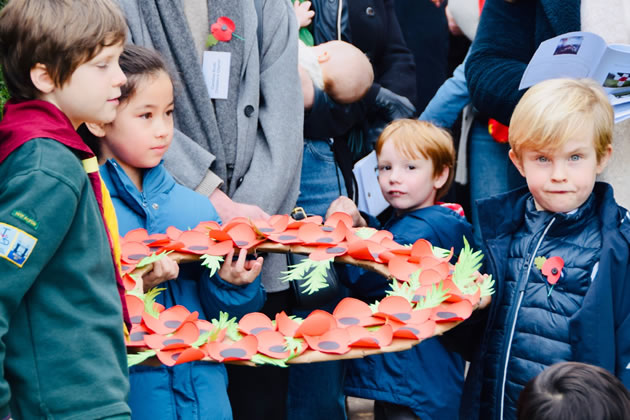
Local scouts present a wreath at a previous Remembrance Sunday in Bedford Park
|
There are a number of acts of remembrance taking place this Sunday (9 November) which are open for all to attend.
A Civic Parade and Ceremony for Remembrance Sunday is taking place in the centre of Chiswick. The civic party will assemble at 10:00am at the Chiswick Memorial Club, located at Bourne Place, W4 2EL. At 10:40am, the parade will depart from the club and proceed to the Chiswick Town Centre Cenotaph on Turnham Green, where the formal Act of Remembrance will be held.
The parade will be joined by parishoners attending services at nearby churches including Our Lady of Grade and St Edward Roman Catholic Church and Christ Church on Turnham Green.
The ceremony will be attended by Mayor Councillor Amy Croft, Council Leader Shantanu Rajawat, Deputy Lieutenant Ms Rosi Prescott, and Opposition Leader Councillor Peter Thompson, among other dignitaries.
St. Michael and All Angels’ Remembrance Sunday Choral Requiem Mass will begin at 9.55am, followed by a solemn procession to the Bedford Park Memorial Seat outside the Parish Hall. There, the Last Post will sound, wreaths will be laid, and the community will observe two minutes’ silence at 11am.
This Remembrance Sunday, the Bedford Park Church also opens its doors to a moving exhibition that bridges generations and conflicts, marking 80 years since the end of World War II and 110 years since the pivotal World War I battles of Gallipoli and Loos.
Running daily until Sunday 16 November , the Remembrance Exhibition 1915–1945–2025 invites visitors to reflect on the enduring impact of war on the Chiswick community. Through personal stories, historic documents, and evocative display panels, the exhibition honours the lives of 15 local men who died in 1915, tracing their homes, regiments, and final battles. Names such as Cyril Austin, Harry Taverner, and Richard Gamble are brought vividly to life, reminding us that every name etched in stone carries a story worth telling.
The exhibition also explores the wartime experiences of children in 1945, with memories of the V1 ‘doodlebug’ that destroyed Chiswick Polytechnic (now ArtsEd) and shattered the East Window of St Michael’s itself. The first V2 rocket to hit Britain landed in Staveley Road, Chiswick, and its legacy is captured in oral histories and archival material featured in the book The People’s War in Chiswick, showcased at this year’s Chiswick Book Festival.
Another highlight is Stranded in France, the illustrated memoir of Joan Langrish, who was just 16 when war broke out while she was staying with her pen-pal in southern France. Her extraordinary journey home via Lisbon and later service in the SIS—under the infamous Kim Philby—offers a rare glimpse into the resilience and courage of young civilians caught in global conflict. Copies are available at the exhibition for £15.
This year’s exhibition is held in memory of David Beresford, the church’s former archivist and churchwarden, who led the World War I Project from 2014 to 2018. His illustrated panels commemorating the 128 names on the church’s war memorials have been lovingly restored by Mike Halson and are once again on display. The accompanying WW1 Project website, supported by the Heritage Lottery Fund, continues to serve as a vital educational resource, mapping the lives and streets of those who served.
St Michael’s Church on Elmwood Road will host a Remembrance Sunday service and attendees are asked to arrive by 10:55am to observe the Act of Remembrance at 11:00am, which will include the reading of Binyon’s Words, the sounding of the Last Post on a bugle, two minutes’ silence, and traditional prayers and reflections.
 The Chiswick War Memorial. Picture: Friends of Turnham Green
On Saturday 22 November at 11:00am at the Katyń Memorial in Gunnersbury Cemetery there will be a gathering at the memorial for a short commemorative service before a guided walk around Gunnersbury Cemetery and a visit to Gunnersbury Park Museum. The museum visit will highlight the story of Poles in the United Kingdom, their wartime contribution and post-war community life, and will place the Katyń remembrance within the broader narrative of Polish-British history.
Like Reading Articles Like This? Help Us Produce More This site remains committed to providing local community news and public interest journalism. Articles such as the one above are integral to what we do. We aim to feature as much as possible on local societies, charities based in the area, fundraising efforts by residents, community-based initiatives and even helping people find missing pets. We've always done that and won't be changing, in fact we'd like to do more. However, the readership that these stories generates is often below that needed to cover the cost of producing them. Our financial resources are limited and the local media environment is intensely competitive so there is a constraint on what we can do. We are therefore asking our readers to consider offering financial support to these efforts. Any money given will help support community and public interest news and the expansion of our coverage in this area. A suggested monthly payment is £8 but we would be grateful for any amount for instance if you think this site offers the equivalent value of a subscription to a daily printed newspaper you may wish to consider £20 per month. If neither of these amounts is suitable for you then contact info@neighbournet.com and we can set up an alternative. All payments are made through a secure web site. One-off donations are also appreciated. Choose The Amount You Wish To Contribute. If you do support us in this way we'd be interested to hear what kind of articles you would like to see more of on the site – send your suggestions to the editor. For businesses we offer the chance to be a corporate sponsor of community content on the site. For £30 plus VAT per month you will be the designated sponsor of at least one article a month with your logo appearing if supplied. If there is a specific community group or initiative you'd like to support we can make sure your sponsorship is featured on related content for a one off payment of £50 plus VAT. All payments are made through a secure web site. |