|
|
||
On the day of its consecration, a letter addressed to the Bishop of London was printed in the Acton, Chiswick & Turnham Green Gazette, accusing Reverend Wilson of “Popish and Pagan mummeries”. Signed by Henry Smith, churchwarden of Chiswick, it listed his supposed transgressions: marching in procession round the church, prostrating himself before the consecrated elements, making the sign of the cross when giving the elements to the people and singing the Agnus Dei. The controversy raged for months in the paper, which sent its own reporter who observed that the service was very “high” and reminiscent of a Roman Catholic Church. From
these foundations, the worshipping tradition of St Michael & All Angels has
remained Anglo-Catholic. St Michael & All Angels was designed by the
influential Victorian architect, Norman Shaw. He is best known for the old New
Scotland Yard building on Victoria Embankment, the Royal Geographical Society in
Kensington and many country houses, including Cragside, a National Trust
property in Northumberland. Shaw succeeded E.W.Godwin as Estate Architect for
Bedford Park and also designed several of its first hou Sir
John Betjeman, the Poet Laureate and architectural writer, described St Michael’s
as “a very lovely church and a fine example of Norman Shaw’s work.” He
recalled that Shaw had written of its design, in a letter to an architect
friend: “I’m a house man - not a church man - and soil pipes are my
speciality.” The Parish Hall (or Parish Room, as it was originally
called) and the adjoining north aisle were added later. The Parish Hall was
designed in the year 1884 (as was the font, completed that year) by another
Bedford Park architect Maurice B. Adams, St. Michael & Al St Michael’s was listed as a historic building in
1951, but until the 1960s, St Michael’s had seen few repairs. During the
Second World War, the roof - as well as most of the stained glass - had been
badly damaged by a bomb that destroyed Chiswick Polytechnic. The stained glass
in the East Window was replaced in 1952 to a design by Lawrence Lee - but other
repair work had been haphazard. Since the mid-60s, there has been regular
renovation - repainting in 1969, central heating in 1975, major restoration of
the external fabric and new roofing in 1980. In 1989, when the church
needed rewiring and new lighting, some of the thousands of pounds needed was
raised by each of the professions in Bedford Park sponsoring one of the
chandeliers, which form the principal lighting in the church. Much of the
remainder came from an unusual source - a film company. St Michael & All
Angels was the setting for “Nuns on the Run”, in which Eric Idle and Robbie
Coltrane played two crooks, who dress up as nuns and hide in a convent. |

 ses, in a distinctive “Queen
Anne Revival” style, using red brick and white joinery. St Michael’s was
intended to reflect that style. It has been described by architects as “theatrical”,
“a mongrel mixing of Gothic and Queen Anne”, “very novel and not very
ecclesiastical”, and “a bold and perceptive character study of a community”.
ses, in a distinctive “Queen
Anne Revival” style, using red brick and white joinery. St Michael’s was
intended to reflect that style. It has been described by architects as “theatrical”,
“a mongrel mixing of Gothic and Queen Anne”, “very novel and not very
ecclesiastical”, and “a bold and perceptive character study of a community”. 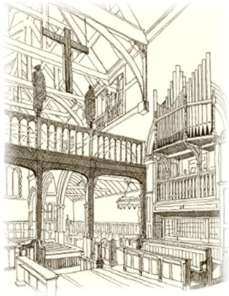 l Angels’ first
churchwarden. It was completed in 1887. The north aisle (including the current
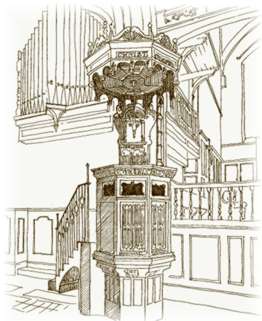
pulpit and the choir stalls) was completed and consecrated in 1892. A fund
was set up to raise money for the Parish Room, through events such as a three-day “Garden Fete and Fancy Fayre” in June 1886, under the patronage of
HRH The Princess Mary Adelaide, Duchess of Teck. This idea was revived in 1967,
as the Bedford Park Festival, and the event - now lasting two weeks - has been
held every June since, to raise money for local charities and the maintenance of
the church buildings.
l Angels’ first
churchwarden. It was completed in 1887. The north aisle (including the current
pulpit and the choir stalls) was completed and consecrated in 1892. A fund
was set up to raise money for the Parish Room, through events such as a three-day “Garden Fete and Fancy Fayre” in June 1886, under the patronage of
HRH The Princess Mary Adelaide, Duchess of Teck. This idea was revived in 1967,
as the Bedford Park Festival, and the event - now lasting two weeks - has been
held every June since, to raise money for local charities and the maintenance of
the church buildings.