Cycling Team Marks Five Years of '100MilesForMax'
Taking on major challenge in memory of Southfield Primary schoolboy
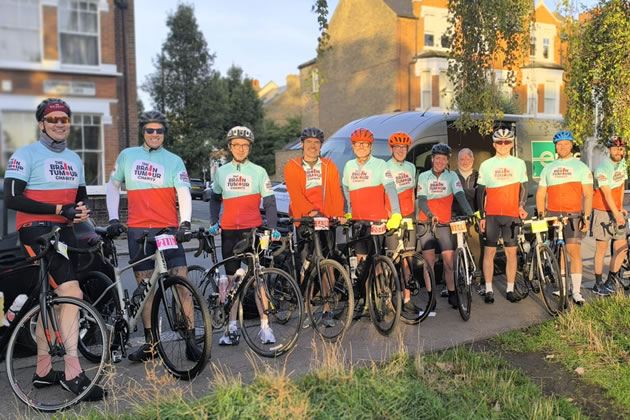
The 100MilesForMax team
April 30, 2026
A Chiswick-based cycling team formed in memory of a Southfield Primary School pupil is marking its fifth anniversary with its biggest challenge yet, as Brain Tumour Awareness Month shines a spotlight on the urgent need for research into childhood brain cancers.
100MilesForMax was created by a group of parents and friends after eight-year-old Maxence was diagnosed with a low-grade glioma. During the long months of treatment at Great Ormond Street Hospital, Max’s father cycled back and forth to visit him — a journey that became the seed of a wider mission. Max died four years after his diagnosis, but the rides continued, growing into a community effort that has now raised more than £60,000 for The Brain Tumour Charity.
What began as one father’s way of coping with the unthinkable has become a Chiswick tradition of remembrance, solidarity and determination. Each year, the team rides 100 miles in Max’s name, honouring his memory while supporting the medical teams and researchers who cared for him.
This year, to mark the group’s fifth anniversary, the cyclists are taking on their most demanding challenge yet: Chase the Sun, a 200-mile coast-to-coast ride from the Isle of Sheppey to Weston-super-Mare on 20 June. The route must be completed between sunrise and sunset, a test of endurance that most of the team — many of them parents with limited long-distance cycling experience — have never attempted before.
“It’s long, it’s tough, but it’s nothing compared to what families facing a brain tumour go through,” the team said as they launched their 2026 campaign.
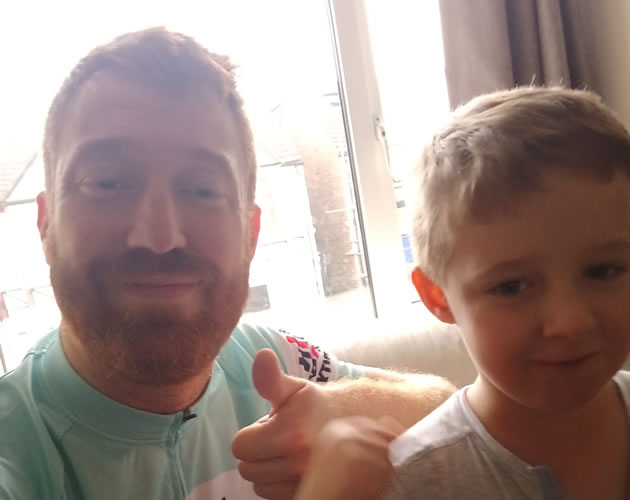
Max (right) with his father
The riders are using the anniversary to highlight the urgent need for new treatments for children with FGFR-altered gliomas — a mutation that affects around 10% of paediatric glioma cases. Research led by Dr Katie Green and Professor Darren Hargrave at Great Ormond Street Hospital has shown that FGFR1 mutations activate a tumour-driving pathway and are often found in midline areas of the brain where surgery is extremely difficult. Despite this, there are currently no approved FGFR-targeted therapies for children, and existing treatments offer only modest results.
For the families affected, more research means more hope — and that is what drives the Chiswick team forward.
“Although Maxence is no longer with us, his spirit drives every mile we ride,” the group said. “Our commitment has only grown stronger.”
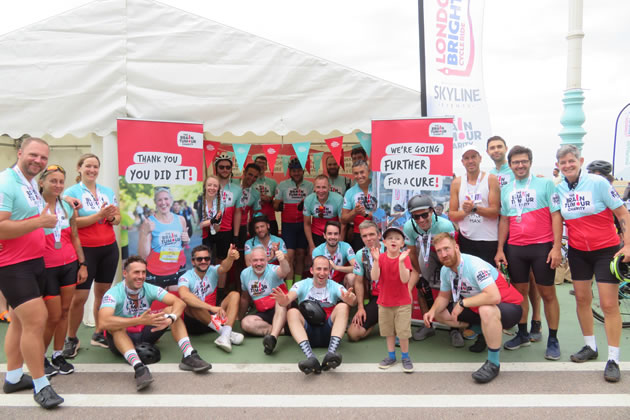
The team after completing a previous challenge
The Brain Tumour Charity, the world’s largest dedicated funder of brain tumour research, will receive all proceeds from this year’s challenge. Donations will help fund laboratory research, support families in crisis and accelerate the development of targeted treatments for children like Max.
Residents are encouraged to support the team as they prepare for the June ride, whether by donating, sharing their story or cheering them on as they train around Chiswick and west London.
Donations can be made via the 100MilesForMax JustGiving page.
Like Reading Articles Like This? Help Us Produce More This site remains committed to providing local community news and public interest journalism. Articles such as the one above are integral to what we do. We aim to feature as much as possible on local societies, charities based in the area, fundraising efforts by residents, community-based initiatives and even helping people find missing pets. We’ve always done that and won’t be changing, in fact we’d like to do more. However, the readership that these stories generates is often below that needed to cover the cost of producing them. Our financial resources are limited and the local media environment is intensely competitive so there is a constraint on what we can do. We are therefore asking our readers to consider offering financial support to these efforts. Any money given will help support community and public interest news and the expansion of our coverage in this area. A suggested monthly payment is £8 but we would be grateful for any amount for instance if you think this site offers the equivalent value of a subscription to a daily printed newspaper you may wish to consider £20 per month. If neither of these amounts is suitable for you then contact info@neighbournet.com and we can set up an alternative. All payments are made through a secure web site. One-off donations are also appreciated. Choose The Amount You Wish To Contribute. If you do support us in this way we’d be interested to hear what kind of articles you would like to see more of on the site – send your suggestions to the editor. For businesses we offer the chance to be a corporate sponsor of community content on the site. For £30 plus VAT per month you will be the designated sponsor of at least one article a month with your logo appearing if supplied. If there is a specific community group or initiative you’d like to support we can make sure your sponsorship is featured on related content for a one off payment of £50 plus VAT. All payments are made through a secure web site. |