Chiswick Tory Candidate Says Lime Bikes a Big Doorstep Issue
Claims decision to ditch e-bike provider not just a concern for younger people
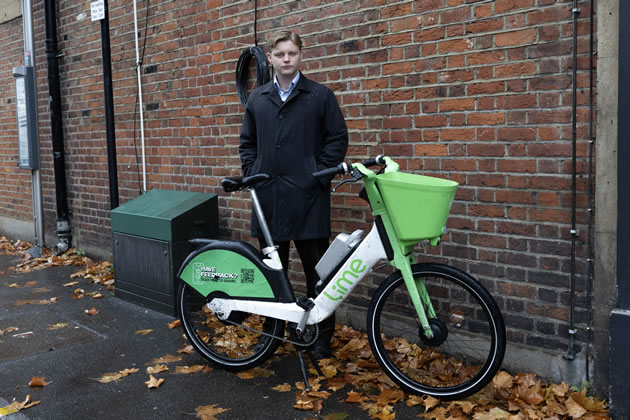
Linden Grigg with a Lime Bike. Picture: Facundo Arrizabalaga/MyLondon
December 12, 2025
A prospective Chiswick councillor has slammed Hounslow Council’s handling of bike hire provision in the borough, claiming its decision to part ways with Lime has caused a huge drop in cycling rates.
Linden Grigg, a 25-year-old parliamentary aide hopes to become a Conservative councillor for Chiswick Homefields ward in 2026. The ward is currently represented by two veteran Tory councillors, John Todd and Gerald McGregor who are stepping down next year. Mr Grigg says the council’s decision to switch away from Lime has caused “chaos”. Hounslow Council chose not to renew its contract with the e-bike provider in August, citing the need for stricter enforcement as a reason for the decision. Forest and Voi are now the firms serving Hounslow with e-bikes.
Initially, riders could not use Lime bikes in the borough at all, and would feel their bike come to a stop as they entered Hounslow. This led to a build up of dumped Lime bikes on bridges in and out of the borough, causing what Linden described as a “safety risk”. This has since been changed so that riders can pass through the east of Hounslow when travelling between neighbouring boroughs.
Speaking to the Local Democracy Reporting Service (LDRS), Linden said he believed the decision was made as a way to raise the most money, rather than the best service for residents – something the council refutes. He added: “I think the council needs to get their story straight on this.
“Why have they made this decision, and why have they not considered reinstating Lime when there is such an appetite to get these bikes back? It can’t be because of enforcement, as Lime ranks higher [than competitors], and it can’t be about prices as [the other provider] increased their prices… we have been left with a substandard service.”
He claims this is an issue that comes up when door knocking, and warns the council not to assume this is a policy which only impacts young people. He added: “I spoke to someone the other night who is a mum, and she told me that it is a pain now because to get anywhere she needs to walk to the border of Hounslow to pick up a bike.”
Hounslow Council accepts that price became a deciding factor in choosing the providers. According to a council spokesperson, “because all bidders met strong quality standards, price became a deciding factor”, adding: “Revenue from the scheme is reinvested into the e-bike scheme (installing parking bays, parking compliance testing, and legal fees), before being used to fund other sustainable transport improvements.”

Linden Grigg on Chiswick High Road. Picture: Facundo Arrizabalaga/MyLondon
Mr Grigg argues that the initial decision to make the entire borough a no-go zone for Lime bikes was itself a financial one, as the council could then charge the company for the removal of bikes. He described areas bordering other boroughs as “checkpoint Charlie” for dumped Lime bikes.
A Hounslow Council spokesperson told the LDRS that the decision to make the borough a no-go zone was “intended to reduce the risk of abandoned Lime e-bikes”.
The council maintains that the enforcement procedure around abandoned Lime bikes is “revenue neutral”, arguing that the costs of removal by Hounslow Highways – a council enforcement agency – is footed by Lime.
Mr Grigg goes on to describe the policy as a failure, claiming that e-bike journeys dropped by over 50,000 journeys a month in Hounslow. Data reportedly shows that Lime recorded 128,000 journeys in July. When the contract ended Voi and Forest between them recorded around 73,000 journeys in just over a month, according to a Freedom of Information request that asked for the number between August 11 and September 15.
He said: “The council has a target of 41 per cent of residents cycling or walking every day, it’s now 37 per cent and it hasn’t been met, which is a direct consequence of this policy.
“The council have put in cycle routes to push people towards active travel, and the downsides of course are that traffic is closed down. That payoff only exists if people are taking the active journeys, which they’re not.”
A council spokesperson told the LDRS that the dip in riders was expected as the transition to the new providers began, but that it is “premature” to make any assessments at this stage. The authority goes on to say “the council is satisfied that this tender process has improved the e-bike scheme”.
The LDRS understands that there is no exclusivity clause in the council’s agreements with both Forest and Voi, meaning that Lime could also operate in the borough simultaneously. Since Lime’s removal, there have been suggestions there are fewer bikes on offer.
Hounslow Council said, “The combined borough-wide fleet size set out in the contract is very similar to the fleet size in the previous Lime MOU. There were fewer e-bikes in the borough during the initial launch period of the new contracts, as the e-bike operators were gradually scaling up their fleets.
“We thank scheme users for their patience during this transition period. As of November, e-bike fleet sizes have now reached the expected level, so residents should notice significantly more e-bikes in the borough than when the new operators first launched in August. Users should also notice a more even geographic spread of the e-bike fleet across the borough.”
Philip James Lynch - Local Democracy Reporter
Like Reading Articles Like This? Help Us Produce More This site remains committed to providing local community news and public interest journalism. Articles such as the one above are integral to what we do. We aim to feature as much as possible on local societies, charities based in the area, fundraising efforts by residents, community-based initiatives and even helping people find missing pets. We’ve always done that and won’t be changing, in fact we’d like to do more. However, the readership that these stories generates is often below that needed to cover the cost of producing them. Our financial resources are limited and the local media environment is intensely competitive so there is a constraint on what we can do. We are therefore asking our readers to consider offering financial support to these efforts. Any money given will help support community and public interest news and the expansion of our coverage in this area. A suggested monthly payment is £8 but we would be grateful for any amount for instance if you think this site offers the equivalent value of a subscription to a daily printed newspaper you may wish to consider £20 per month. If neither of these amounts is suitable for you then contact info@neighbournet.com and we can set up an alternative. All payments are made through a secure web site. One-off donations are also appreciated. Choose The Amount You Wish To Contribute. If you do support us in this way we’d be interested to hear what kind of articles you would like to see more of on the site – send your suggestions to the editor. For businesses we offer the chance to be a corporate sponsor of community content on the site. For £30 plus VAT per month you will be the designated sponsor of at least one article a month with your logo appearing if supplied. If there is a specific community group or initiative you’d like to support we can make sure your sponsorship is featured on related content for a one off payment of £50 plus VAT. All payments are made through a secure web site. |