Strand on the Green Pollution Not From Misconnected Sewers
Thames Water's investigation work identifies faulty flap valve
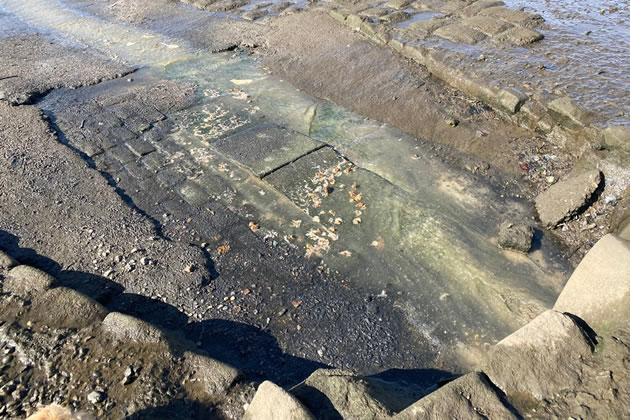
Sewage flowing into the river by Ship Alley. Picture: Anita Milewczyk
|
May 11, 2025
Thames Water has confirmed it has concluded its investigations into the cause of the flow of sewage into the river by Strand on the Green.
A month ago, ChiswickW4.com highlighted reports of foul water discharges from the outflow by Ship Alley which had been seen by local residents.
Thames Water said at the time that they suspected that misconnected sewers could be responsible and sent engineers to the site a few days later. Its spokesperson said that it was possible that up to 10% of properties in the area had incorrectly connected pipes into the storm rather than the sewage system. Concerns were raised that some of the Georgian properties by the river, which were built before the sewerage infrastructure was put in place, could have been designed to discharge foul water directly into the Thames.
However, Thames Water now says that no misconnected properties have been identified in the area and the discharges into the river by Ship Alley were due to a faulty flap valve and a defect in its foul water sewer.
A flap valve in a sewerage system is a type of non-return valve (or check valve) that allows wastewater or stormwater to flow in only one direction—out of a pipe or outlet—and prevents backflow.
The surface water pipe at Ship Alley has now been relined after permission to proceed with the work was granted by the Port of London Authority to conduct excavations around the towpath.
It is hoped that the repair should result in a significant improvement in water quality in the area. There has been no reported discharge of sewage from the outflows in the surrounding area which are monitored by the Environment Agency since last October following the connection of the Tideway Tunnel or ‘Super Sewer’. However, the Ship Alley culvert was not monitored as the pipe was not meant to be connected to the system to carry foul water to the sewage treatment works
The problems at Strand on the Green may account for recent measurements showing Chiswick had the worst water quality of any point on the course of the University Boat Race. Environmental campaign group River Action tested at various locations along the route and found the highest levels of E.coli content near Chiswick Bridge where the race ends. A total of 41 samples were taken and the highest reading (2,267 colony-forming units /100ml) was recorded at Chiswick Bridge. This is more than twice the Environment Agency and World Health Organisation thresholds for safe recreation. This led to Olympian Sir Steve Redgrave ask the Oxford and Cambridge crews to refrain from the traditional celebration of throwing the boat’s cox into the water at the end of the race.
Another cause of the high E.coli content in the water near Chiswick could be the treated wastewater put into the water from the Mogden sewage treatment plant. Thames Water is not legally obliged to completely remove E.coli from these discharges. As the river is not regarded as a bathing water area it is not funded to routinely disinfect or sterilise final effluent.
Like Reading Articles Like This? Help Us Produce More This site remains committed to providing local community news and public interest journalism. Articles such as the one above are integral to what we do. We aim to feature as much as possible on local societies, charities based in the area, fundraising efforts by residents, community-based initiatives and even helping people find missing pets. We've always done that and won't be changing, in fact we'd like to do more. However, the readership that these stories generates is often below that needed to cover the cost of producing them. Our financial resources are limited and the local media environment is intensely competitive so there is a constraint on what we can do. We are therefore asking our readers to consider offering financial support to these efforts. Any money given will help support community and public interest news and the expansion of our coverage in this area. A suggested monthly payment is £8 but we would be grateful for any amount for instance if you think this site offers the equivalent value of a subscription to a daily printed newspaper you may wish to consider £20 per month. If neither of these amounts is suitable for you then contact info@neighbournet.com and we can set up an alternative. All payments are made through a secure web site. One-off donations are also appreciated. Choose The Amount You Wish To Contribute. If you do support us in this way we'd be interested to hear what kind of articles you would like to see more of on the site – send your suggestions to the editor. For businesses we offer the chance to be a corporate sponsor of community content on the site. For £30 plus VAT per month you will be the designated sponsor of at least one article a month with your logo appearing if supplied. If there is a specific community group or initiative you'd like to support we can make sure your sponsorship is featured on related content for a one off payment of £50 plus VAT. All payments are made through a secure web site. |