Proposal Made to Turn Acton Lane Offices into 39 Flats
Developer wants to add extra floor to the Dukes Gate building
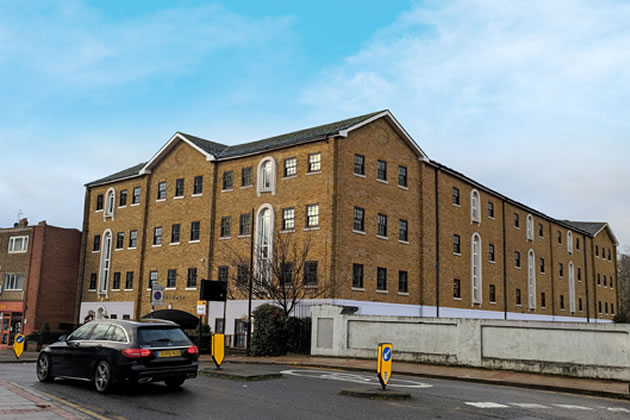
Dukes Gate is on Acton Lane near Chiswick Park tube station
March 13, 2026
A prominent commercial building near Chiswick Park Underground Station is the subject of two simultaneous planning applications that could see it converted into nearly 40 flats.
Permission is being sought for a change of use from office to residential at the Dukes Gate building on Acton Lane plus the addition of an extra floor.
The two applications, both currently under consultation, would deliver up to 39 new homes. The first (PAC/2026/0807) seeks prior approval for the change of use of the existing commercial building into 29 self-contained flats. The second (PA/2026/0809) seeks prior approval for a one-storey upward extension to create an additional 10 residential units on a new fourth floor.
Dukes Gate is a three-storey yellow stock brick building arranged in a U-shape around a south-facing courtyard. It sits on Acton Lane in Chiswick, within the London Borough of Hounslow but right on the border with Ealing. On the north side it runs directly alongside the District and Piccadilly line railway tracks. Chiswick Park Underground Station lies just to the north, beyond the railway bridge.
Directly opposite Dukes Gate on Acton Lane sits the Sainsbury's Chiswick supermarket, which the retailer is planning to redevelop into a mixed use development with towers expected to be around 14 storeys high with over 300 flats.
The Dukes Gate site has been the subject of a series of approved schemes over the past two years that have steadily established the principle of change of use.
In September 2024, the council granted prior approval (PAC/2024/1338) for an upward extension to add a single additional storey providing 10 self-contained flats, while retaining the existing commercial use on the floors below. That consent established the viability of rooftop residential development on the building, with the proposed extension designed to closely follow the existing roofscape and match the building's brick character.
A month later, in October 2024, full planning permission was granted under P/2024/2114 for a series of façade alterations to the existing building — including changes to external windows and doors, the introduction of new windows on the north elevation, and the addition of roof windows. These consents were progressed independently of one another, and the architects, Studio Tivoli, acknowledge in its supporting documentation that when the two approved schemes are considered together, the resulting building lacks full architectural cohesion.
To address this, a further concurrent application (P/2026/0284) has been submitted for additional façade refinements, replacing the existing arched windows with square-topped, painted timber-framed windows with splayed brick heads, introducing inward-facing gabled roof extensions above the courtyard bays, and replacing the arched metal grille openings at lower ground floor level on the north elevation with proper timber-framed windows.
Studio Tivoli, acting for the applicant Midshires Estates Limited — a Warwickshire-based property company — has set out a detailed case for why the consolidated scheme represents good design. The upward extension is designed to mirror the massing and roof form of the existing building, with new window openings vertically aligned with those on the floors below. Materials are specified to match the existing London stock brick, natural slate roof and painted timber joinery already present on the building.
The floor-to-ceiling height of the new third floor is confirmed at 2,550mm internally — within the permitted development limit of 3 metres — and the overall extended building height of just over 23.7 metres falls within the 30-metre ceiling imposed by Class AA of the General Permitted Development Order.
The architects argue that the proposed extension will have little visual impact on the surrounding area. It says that wireline views taken from the Chiswick Park station platform, from Turnham Green and from Gunnersbury Triangle suggest the additional storey will be largely absorbed into the existing townscape, particularly when set against the considerably taller buildings already present or planned nearby.
Whether both applications succeed will depend on the council's assessment of the prior approval criteria — principally the impact on transport, flooding risk, contamination, and the design quality of the upward extension. Given that the principle of the rooftop storey was already approved in 2024, the design case for the current application is established. The change-of-use element is a newer and more significant step, removing all commercial floorspace from a building that currently provides employment.
Consultations on both applications are currently open and comments can be made on the planning section of the council’s web site using the reference numbers above to search.
Like Reading Articles Like This? Help Us Produce More This site remains committed to providing local community news and public interest journalism. Articles such as the one above are integral to what we do. We aim to feature as much as possible on local societies, charities based in the area, fundraising efforts by residents, community-based initiatives and even helping people find missing pets. We’ve always done that and won’t be changing, in fact we’d like to do more. However, the readership that these stories generates is often below that needed to cover the cost of producing them. Our financial resources are limited and the local media environment is intensely competitive so there is a constraint on what we can do. We are therefore asking our readers to consider offering financial support to these efforts. Any money given will help support community and public interest news and the expansion of our coverage in this area. A suggested monthly payment is £8 but we would be grateful for any amount for instance if you think this site offers the equivalent value of a subscription to a daily printed newspaper you may wish to consider £20 per month. If neither of these amounts is suitable for you then contact info@neighbournet.com and we can set up an alternative. All payments are made through a secure web site. One-off donations are also appreciated. Choose The Amount You Wish To Contribute. If you do support us in this way we’d be interested to hear what kind of articles you would like to see more of on the site – send your suggestions to the editor. For businesses we offer the chance to be a corporate sponsor of community content on the site. For £30 plus VAT per month you will be the designated sponsor of at least one article a month with your logo appearing if supplied. If there is a specific community group or initiative you’d like to support we can make sure your sponsorship is featured on related content for a one off payment of £50 plus VAT. All payments are made through a secure web site. |