Traffic Slowed Across Chiswick Last Year
Average speeds down with delays up particularly on Burlington Lane
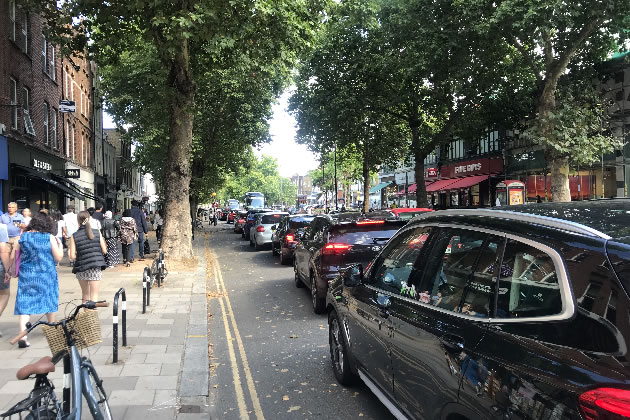
Sometimes pedestrians move more quickly along Chiswick High Road than motor vehicles
March 14, 2025
New official figures are suggesting that Chiswick’s traffic problems are getting worse with average speeds down and delays up on most local roads last year.
The most striking rise was on Burlington Lane, which is managed by Transport for London, which seems to be experiencing consistently rising congestion. The average speed on the 1.37 mile stretch from Chiswick Bridge to Hogarth Roundabout fell to 13.9mph in 2024 having been 14.1mph the previous year and 17.9mph in 2019 before the pandemic. This has increased the average delay by 24 seconds. It is understood that most of these delays are occurring at the northern end of the Road.
Chiswick Lane, which is controlled by Hounslow Council, also saw more delays having previously seen traffic flow speed up since 2019. Last year the average speed fell from 10.1 mph to 9.4 mph. Motorists on average are now delayed by an average of 1 minute 47 seconds on this half mile stretch of road, 17 seconds more than the previous year.
There was however better news on Chiswick High Road where there was a very marginal reduction in delays last year. The average delay for a vehicle travelling the length of the High Road from King Street to Chiswick High Road was 6 minutes and 11 seconds down from 6 minutes 31 seconds which marginally boosted the average speed on the road to 8.9mph from 8.8mph. However, this is still well below the 9.8mph for the same stretch of road recorded in 2019 when average delays were just over 5 minutes.
The congestion on Chiswick High Road appears to be concentrated in the central section in the main shopping area which has seen delays increase by over a minute, even allowing for some improvement this year, since the pandemic in a relatively short section.
It is believed that improved travel times this year in this section are a result of an upgrade to the traffic lights at the Chiswick Lane junction.
Although the changes in delays seem relatively small, the numbers given are averages and at peak times the delays will be multiples of the average while there will be no delay at all when traffic is light. This means apparently insignificant increases in average delays can have a disproportionate impact on congestion. Although the average speed on the High Road is over 8mph, traffic is regularly observed moving at less than walking pace when the roads are busy.
| Traffic Delays and Average Speeds in Chiswick | ||||||||||
|---|---|---|---|---|---|---|---|---|---|---|
Road (Count Point ID) |
Length in Miles |
2024 |
2023 |
2019 |
2024 |
2023 |
2019 |
2024 |
2023 |
2019 |
|
|
Delay/ seconds per mile |
Average Speed (mph) |
Delay in seconds |
||||||
A315 King Street - Goldhawk Road to Studland Street (6897) |
0.5 |
135.3 |
166.0 |
129.3 |
10.4 |
9.7 |
11.2 |
67.7 |
83.0 |
64.7 |
A315 Chiswick High Road - Chiswick Lane to King Street(36947) |
0.31 |
122.9 |
126.0 |
157.9 |
10.2 |
10.2 |
9.9 |
61.5 |
63.0 |
79.0 |
A315 Chiswick High Road - Heathfield Terrace to Chiswick Lane (16867) |
0.5 |
314.7 |
335.7 |
181.1 |
6.2 |
6.0 |
8.6 |
157.5 |
167.9 |
90.6 |
A315 Chiswick High Road - Chiswick Roundabout to Heathfield Terrace (56697) |
0.87 |
169.5 |
155.0 |
147.1 |
9.1 |
9.5 |
9.7 |
84.8 |
77.5 |
73.6 |
Whole length of Chiswick High Road |
2.18 |
|
|
|
|
|
|
371.2 |
391.4 |
307.7 |
Chiswick Lane (36951) |
0.5 |
214.6 |
180.6 |
212.8 |
9.4 |
10.1 |
9.6 |
107.3 |
90.3 |
106.4 |
Burlington Lane (48572) |
1.37 |
111.7 |
107.9 |
63.4 |
13.9 |
14.1 |
17.9 |
55.9 |
54.0 |
31.7 |
Source: Department for Transport
London TravelWatch issued a report last year which showed that bus travel times had fallen by 10% over the last decade with the average speed down to 9.4% across the borough of Hounslow. This falls to 8mph in Hammersmith & Fulham confirming that speeds decrease closer to central London.
The average speed and delay numbers are taken from the Department for Transport web site and is based on ArcGIS (Geographic Information System) data. This is a mapping and spatial analysis tool developed by Esri (Environmental Systems Research Institute). It combines various types of geographic data — like maps, satellite imagery, demographics, infrastructure data, and transportation networks — into visual layers that help users analyse and interpret spatial information. It is used by the Department for Transport for analysing traffic flow, congestion patterns, and travel demand.
Councillor Shivraj Grewal, Hounslow Council’s Cabinet Member for Infrastructure, Recycling and Transformation, said, “Factors which contribute to traffic changes are wide-ranging and include increased economic activity, higher car ownership and new housing developments along the network. In addition, local factors - such as disruptions caused by utility company works or construction activities - also impact.
“Hounslow Council regularly monitors the network and has taken a range of measures to make roads safer and to promote walking and cycling to reduce reliance on cars. The most sustainable solution to traffic increases is to encourage walking and cycling for shorter journeys and public transport use, where we work closely with TfL and London Buses.”
We have asked Transport for London for comment on these numbers.
Like Reading Articles Like This? Help Us Produce More This site remains committed to providing local community news and public interest journalism. Articles such as the one above are integral to what we do. We aim to feature as much as possible on local societies, charities based in the area, fundraising efforts by residents, community-based initiatives and even helping people find missing pets. We’ve always done that and won’t be changing, in fact we’d like to do more. However, the readership that these stories generates is often below that needed to cover the cost of producing them. Our financial resources are limited and the local media environment is intensely competitive so there is a constraint on what we can do. We are therefore asking our readers to consider offering financial support to these efforts. Any money given will help support community and public interest news and the expansion of our coverage in this area. A suggested monthly payment is £8 but we would be grateful for any amount for instance if you think this site offers the equivalent value of a subscription to a daily printed newspaper you may wish to consider £20 per month. If neither of these amounts is suitable for you then contact info@neighbournet.com and we can set up an alternative. All payments are made through a secure web site. One-off donations are also appreciated. Choose The Amount You Wish To Contribute. If you do support us in this way we’d be interested to hear what kind of articles you would like to see more of on the site – send your suggestions to the editor. For businesses we offer the chance to be a corporate sponsor of community content on the site. For £30 plus VAT per month you will be the designated sponsor of at least one article a month with your logo appearing if supplied. If there is a specific community group or initiative you’d like to support we can make sure your sponsorship is featured on related content for a one off payment of £50 plus VAT. All payments are made through a secure web site. |