All Pain No Gain for Chiswick's Cinderella Tube Service
District line closures continue with no prospect of improvement
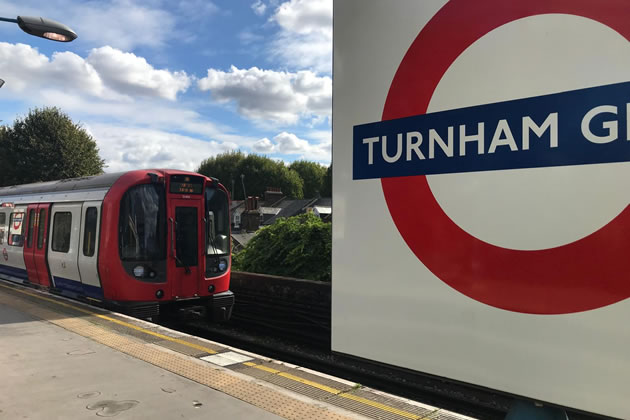
A District Line train arriving at Turnham Green station. Picture: ChiswickW4.com
September 28, 2025
With yet another series of engineering works this weekend (27 – 28 September) on the western branches of the District line, users of station in the Chiswick area are increasingly despairing of any prospect of improvement in the services.
Dubbed by local MP Andy Slaughter as the ‘Cinderella’ section of the line, the Richmond branch in particular has been plagued with signal failures as the aging infrastructure crumbles. There was some hope that increased government funding for Transport for London (TfL) for its ‘Four Line Modernisation’ plan would enable an upgrade of the signals in the area from systems which in some cases date back to the early part of last century.
There are at least nine separate weekends of major planned suspensions for the western District line over a five-month period, spanning May to October. We asked TfL if the string of weekend closures that have been taking place were to enable investment in modernisation but it did not respond. Along with the branch down to Wimbledon, the Richmond branch appears to have been omitted from the programme if digitalisation of signalling on the District Line which could have significantly reduced failures and service interruptions as well as boosting the capacity of the line. The regular weekend interruptions are apparently for basic maintenance and responses to emerging technical problems.
While the Four Lines Modernisation (4LM) programme promises to bring advanced signalling technology to several lines, including parts of the District Line, there is currently no confirmed timeline for its extension to the Richmond branch. This leaves Chiswick passengers in limbo, enduring ongoing disruption without the assurance of future improvements.
The root of the issue lies in the age and complexity of the infrastructure. The District Line is part of the sub-surface network—alongside the Circle, Hammersmith & City, and Metropolitan lines—which includes some of the oldest sections of the London Underground, dating back to 1863. Much of the signalling equipment still in use on the Richmond and Ealing Broadway branches west of Barons Court is decades old, relying on outdated track circuits and relay-based systems that are prone to failure. These legacy systems struggle to cope with modern operational demands, leading to the spike in emergency closures and signal faults that have plagued the Richmond branch since mid-2024.
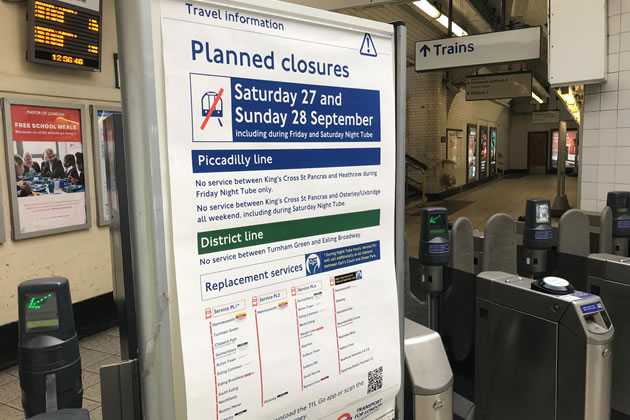
Weekend engineering works have consistently deprived Chiswick residents of a tube service. Picture: ChiswickW4.com
The S-Stock trains in use across the line remain fitted with tripcocks (a type of safety brake that activates upon passing a red signal), a technology dating to early 20th-century railway practice, as a failsafe for these legacy signalling areas. Particularly on the Richmond and Wimbledon branches, train operations interface with manual control panels, sometimes based at local or shared Network Rail locations, with varying levels of automation compared with the line’s central sections. With manual and analogue interlocking, identifying and fixing failures requires site visits and can close whole sections for extended periods. Maintenance interventions are cumbersome and require long-duration closures.
The 4LM programme is designed to address these deficiencies by introducing a state-of-the-art communications-based train control (CBTC) signalling system. This £800 million upgrade promises faster, more frequent, and more reliable services, with trains capable of running at up to 32 per hour during peak times. However, while large portions of the District Line—particularly the eastern end between Stepney Green and Upminster—have already benefited from these improvements, the Richmond branch remain untouched.
The Ealing Broadway branch (SMA 9) is largely completed and operating under new digital signals but the branches west of Stamford Brook (to Richmond) and south of East Putney (to Wimbledon), as well as the “Richmond chord” (SMA 11), remain on legacy signalling. The western most section of the District line—Richmond branch, and also the Wimbledon branch—has formally been excluded ("de-scoped") from the currently funded 4LM rollout as of 2024, with no date or funding commitment for their incorporation to digital signalling.
The delay in upgrading the western section is not simply a matter of scheduling. Technically, the Richmond branch presents unique challenges. It shares track with the London Overground and South Western Railway, creating complex operational interfaces that complicate the installation and integration of CBTC. Coordinating upgrades across multiple operators and ensuring compatibility with different signalling systems has proven to be a slow and intricate process. Additionally, the Richmond branch includes several junctions and interchanges that require bespoke solutions, further slowing progress. For now, TfL appears to have decided that, with the available funding, these challenges are too severe and upgrades are at best postponed but with no date offered for any work to begin.
The plan appears to be to maintain legacy signalling, patching and renewing only as necessary to ensure basic safety and reliability. decades of underinvestment in the signalling and track assets west of Barons Court/Fulham Broadway have resulted in a high maintenance backlog. Routine works often expose further latent deficiencies, requiring additional planned blockades for effective resolution.
Statements from both TfL and Network Rail (the infrastructure manager for much of this stretch) confirm a rise in failures affecting the Richmond–Kew–Gunnersbury area, with public acknowledgements from Mayoral Question Time and the London Assembly underscoring a "regular issue" with District line reliability in West London. Putney MP Fleur Anderson has also been regularly raising the issue of a poor service on the Wimbledon branch with TfL.
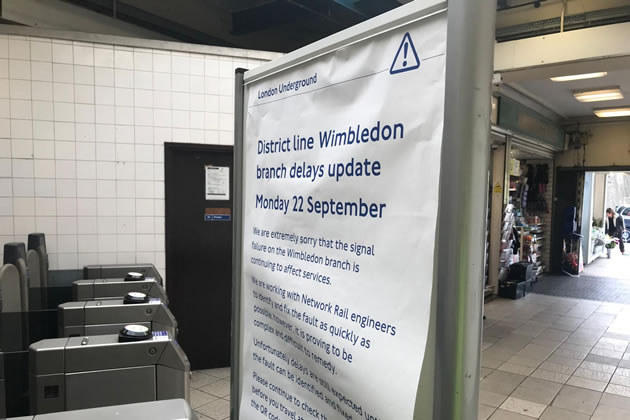
The Wimbledon branch is also regularly hit by signal failures
Adding to the frustration is the absence of any compensating upgrade to the Piccadilly Line, which could potentially offer relief. Turnham Green station, which sits on both the District and Piccadilly lines, has long been the subject of local campaigns for increased Piccadilly Line service. However, without a corresponding signalling upgrade on the Piccadilly Line, there is no realistic prospect of regular stopping services at Turnham Green in the near future. While TfL continues to promote the long-term benefits of the 4LM programme, the western end of the District Line remains a glaring gap in the network’s modernisation efforts compromising the service across the whole line, not just for users of the local branch.
Andy Slaughter MP said, “The Richmond Branch has always been the Cinderella service on the District Line, perhaps on the whole tube system. Various excuses have been given over the years – poor track and signalling, failure to synch TfL and Network Rail services – but all this should have been history after the major upgrade which has brought new signalling and rolling stock to the line. The Richmond service is an embarrassment at present and hugely frustrating for passengers. Network Rail own the track and are the main culprits, but TfL passengers are equally affected. The situation has gone on too long and needs urgent attention – and this should include the necessary upgrade of Gunnersbury station to provide better and step-free access.”
Details of forthcoming engineering works on the Richmond branch will be published in the weekly ChiswickW4.com newsletter.
Like Reading Articles Like This? Help Us Produce More This site remains committed to providing local community news and public interest journalism. Articles such as the one above are integral to what we do. We aim to feature as much as possible on local societies, charities based in the area, fundraising efforts by residents, community-based initiatives and even helping people find missing pets. We've always done that and won't be changing, in fact we'd like to do more. However, the readership that these stories generates is often below that needed to cover the cost of producing them. Our financial resources are limited and the local media environment is intensely competitive so there is a constraint on what we can do. We are therefore asking our readers to consider offering financial support to these efforts. Any money given will help support community and public interest news and the expansion of our coverage in this area. A suggested monthly payment is £8 but we would be grateful for any amount for instance if you think this site offers the equivalent value of a subscription to a daily printed newspaper you may wish to consider £20 per month. If neither of these amounts is suitable for you then contact info@neighbournet.com and we can set up an alternative. All payments are made through a secure web site. One-off donations are also appreciated. Choose The Amount You Wish To Contribute. If you do support us in this way we'd be interested to hear what kind of articles you would like to see more of on the site – send your suggestions to the editor. For businesses we offer the chance to be a corporate sponsor of community content on the site. For £30 plus VAT per month you will be the designated sponsor of at least one article a month with your logo appearing if supplied. If there is a specific community group or initiative you'd like to support we can make sure your sponsorship is featured on related content for a one off payment of £50 plus VAT. All payments are made through a secure web site. |