Dukes Meadows Bird Survey Enters New Phase
Quarterly walks resume this month as part of citizen-science initiative
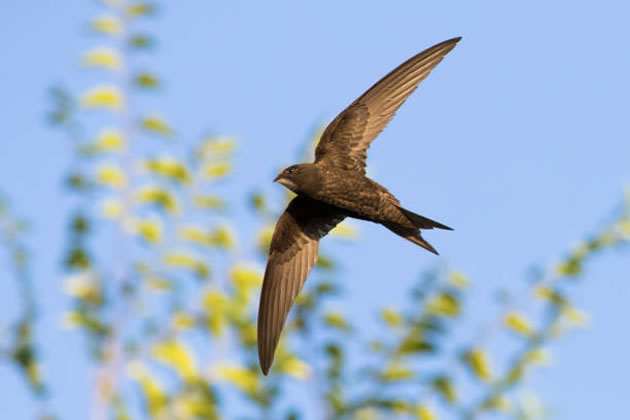
A swift
May 22, 2026
The Dukes Meadows bird-monitoring project will take its next step on Sunday 31 May, when volunteers gather for the first quarterly survey walk of 2026.
The walk begins at 10am from the Bowls Club café beside the Farmers Market and marks the start of a new phase in a citizen-science initiative that has steadily grown in scope and ambition over the past year.
The surveys began in March 2025 as a monthly programme designed to build a detailed baseline of bird activity across the park. Over twelve months, volunteers recorded species across the meadows, hedgerows, orchard and riverbank, creating the most comprehensive picture yet of how birds use the site throughout the seasons. With that baseline now complete, the project has shifted to quarterly walks to monitor long-term trends and ecological changes.
The initiative is organised by Dukes Meadows Trust in partnership with RSPB London and is led by RSPB volunteer Andrew Peel, who has guided the walks since their launch. He says the site offers an unusually rich mix of habitats for an urban park. “Dukes Meadows is an interesting place to see birds, as it has many different types of habitat,” he explains. “Dukes Meadows Trust has planted what was a bare space, with native hedgerows, trees and an orchard and planted up meadow areas. That has enhanced the area for wildlife.”
The Thames, which runs alongside the park, adds another layer of ecological interest. “The river creates an opportunity to see waterfowl, and the river is a useful corridor for birds,” Andrew says. “Last year we saw Sand Martins nesting in the river wall. These may have spread out from birds that have been migrating to the London Wetland Centre. We may also see Swifts, another summer visitor that has been seen flying over the Meadows.”
Last year’s monthly surveys recorded a wide range of species, from resident Robins and Wrens to seasonal visitors such as Chiffchaffs and Blackcaps. The discovery of Sand Martins nesting in the river wall was one of the most notable findings, offering a rare glimpse of a species more commonly associated with larger wetland reserves. Volunteers also observed how the Trust’s long-term habitat-creation work — including the orchard, hedgerows and meadow areas — has steadily increased biodiversity, providing food and shelter for birds throughout the year.
The move to quarterly surveys reflects the project’s shift from baseline data-gathering to long-term monitoring. Organisers say this is where citizen science becomes especially valuable, helping to track how wildlife responds to changes in habitat, climate and land management over time.
The walks are open to anyone with an interest in nature, regardless of experience. Participants learn how to identify birds by sight and sound, and the data collected contributes to a growing record shared with conservation partners.
Residents can sign up for the May walk and receive updates about future surveys online.
Like Reading Articles Like This? Help Us Produce More This site remains committed to providing local community news and public interest journalism. Articles such as the one above are integral to what we do. We aim to feature as much as possible on local societies, charities based in the area, fundraising efforts by residents, community-based initiatives and even helping people find missing pets. We’ve always done that and won’t be changing, in fact we’d like to do more. However, the readership that these stories generates is often below that needed to cover the cost of producing them. Our financial resources are limited and the local media environment is intensely competitive so there is a constraint on what we can do. We are therefore asking our readers to consider offering financial support to these efforts. Any money given will help support community and public interest news and the expansion of our coverage in this area. A suggested monthly payment is £8 but we would be grateful for any amount for instance if you think this site offers the equivalent value of a subscription to a daily printed newspaper you may wish to consider £20 per month. If neither of these amounts is suitable for you then contact info@neighbournet.com and we can set up an alternative. All payments are made through a secure web site. One-off donations are also appreciated. Choose The Amount You Wish To Contribute. If you do support us in this way we’d be interested to hear what kind of articles you would like to see more of on the site – send your suggestions to the editor. For businesses we offer the chance to be a corporate sponsor of community content on the site. For £30 plus VAT per month you will be the designated sponsor of at least one article a month with your logo appearing if supplied. If there is a specific community group or initiative you’d like to support we can make sure your sponsorship is featured on related content for a one off payment of £50 plus VAT. All payments are made through a secure web site. |