Chiswick House Conservatory Added to At Risk Register
Historic England raising concern about future of historic glasshouse
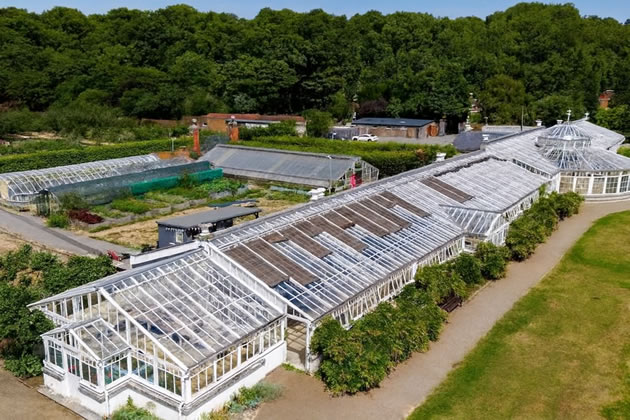 Aerial view of the conservatory in Chiswick House Gardens. Picture: Historic England
November 6, 2025
The Conservatory at Chiswick House Gardens has been officially added to Historic England’s Heritage at Risk Register 2025, marking the first time the iconic glasshouse has appeared on the national list of vulnerable historic sites. The register, published this week, provides an annual snapshot of the condition of England’s most valued buildings and landscapes, aiming to guide restoration efforts and ensure long-term public benefit. The conservatory was added to the Register following an assessment of its condition, which highlighted the fragility of the 1930s timber and glass structure and the need for major conservation work.
In December 2022, the building was closed indefinitely due to safety risks, with emergency repairs estimated to cost over £5 million. The Chiswick House & Gardens Trust (CHGT), which manages the site on behalf of Hounslow Council which is the owner, has acknowledged the need for “radical action” and is actively exploring long-term solutions to restore the building. While the building has undergone several restorations, its unique design and age mean that ongoing repairs can no longer keep pace with the effects of weathering, such as increased rainfall and higher temperatures. The Trust has previously reassured the public that demolition is not being considered, and that the Conservatory remains a priority for restoration.
Commissioned in the 19th century by the sixth Duke of Devonshire and designed by Samuel Ware, the architect of Burlington Arcade, the Conservatory is a rare example of Regency glasshouse architecture. It is especially renowned for its camellia collection, some of which were planted nearly 200 years ago. These blooms became the centrepiece of the annual Camellia Festival, which had previously drawn thousands of visitors each spring.
Hounslow Council is presenting the new Heritage at Risk status as a positive development as it enables it and the Trust to approach a wider range of funding sources and partners to fund a restoration.
Councillor Salman Shaheen, Cabinet Member for Culture, Leisure and Public Spaces at Hounslow Council, said, “We welcome the news that the conservatory has been added to Historic England’s Heritage At Risk Register. It’s remarkable, and testament to the dedication generations have shown to protect this precious building, that it’s still standing at almost 100 years old, having seen major repairs in the 1950s, 90s and in 2008. The Council has also funded annual repairs since 2020.
“However, the full restoration needed to secure its future will cost millions of pounds. We hope that the conservatory’s new status on the At Risk Register will help us and Chiswick House and Gardens Trust secure the necessary grant funding to return the conservatory to its former glory.”
Earlier this year, the Trust completed the conservation and repurposing of the original Victorian working areas behind the glass and timber of the conservatory, turning them into artist studios. This Community and Creative Campus opened in May and is now used by 18 local artists.
Xanthe Arvanitakis, Director of Chiswick House & Gardens Trust, said, “The glasshouse is an iconic and beautiful garden building that links our formal and productive gardens and provides a stunning focal point for visitors. Chiswick House and Gardens Trust has implemented the first stages of a sustainable, long-term approach to its future with the creation of these artists’ studios. We are committed to developing a sustainable approach to the glassed building, learning from the recent past, mindful of future challenges and with the local community’s involvement and benefit at its heart.”
Historic England says it wants to see “at risk” buildings brought back into productive use, allowing them to serve local communities.
Chris Laine, Landscape Architect at Historic England, said, "The Heritage at Risk Register draws attention to historic places in need and helps bring partners together to explore opportunities for repair and renewal.
“The conservatory is not an easy structure to maintain and its condition reflects issues inherent in the unique design and materials. We're working closely with Hounslow Council and Chiswick House and Gardens Trust to find a way forward to secure the whole building's future, building on the excellent work done to transform the Victorian working areas into artists' studios."
The organisation’s joint chief executives, Claudia Kenyatta and Emma Squire, said in a joint statement, “The best way to protect our buildings is to reuse them, turning them into places of local connection and joy.
“The sites that have been saved and have come off the register this year really highlight the benefits of working together in partnership, and with communities, to create positive, sustainable change.”
The 2025 register includes 4,891 entries, with 129 removed this year due to successful restoration and 138 added due to new or worsening concerns. Other London sites added include the Hill Garden Pergola on Hampstead Heath, while among those rescued was the Grade II-listed Leaning Woman statue in Hammersmith.
CHGT continues its campaign to secure funding and develop sustainable uses for the building. For more on the restoration strategy, visit Historic England.
Like Reading Articles Like This? Help Us Produce More This site remains committed to providing local community news and public interest journalism. Articles such as the one above are integral to what we do. We aim to feature as much as possible on local societies, charities based in the area, fundraising efforts by residents, community-based initiatives and even helping people find missing pets. We've always done that and won't be changing, in fact we'd like to do more. However, the readership that these stories generates is often below that needed to cover the cost of producing them. Our financial resources are limited and the local media environment is intensely competitive so there is a constraint on what we can do. We are therefore asking our readers to consider offering financial support to these efforts. Any money given will help support community and public interest news and the expansion of our coverage in this area. A suggested monthly payment is £8 but we would be grateful for any amount for instance if you think this site offers the equivalent value of a subscription to a daily printed newspaper you may wish to consider £20 per month. If neither of these amounts is suitable for you then contact info@neighbournet.com and we can set up an alternative. All payments are made through a secure web site. One-off donations are also appreciated. Choose The Amount You Wish To Contribute. If you do support us in this way we'd be interested to hear what kind of articles you would like to see more of on the site – send your suggestions to the editor. For businesses we offer the chance to be a corporate sponsor of community content on the site. For £30 plus VAT per month you will be the designated sponsor of at least one article a month with your logo appearing if supplied. If there is a specific community group or initiative you'd like to support we can make sure your sponsorship is featured on related content for a one off payment of £50 plus VAT. All payments are made through a secure web site. |