Could Phone Boxes Be About to Disappear from Chiswick?
BT plans to remove its remaining ones to replace with Street Hubs
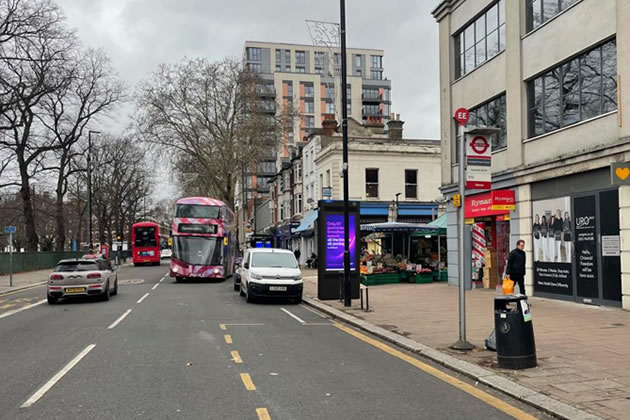
A visualisation from planning documents of the proposed Street Hub by Rymans
March 31, 2026
A wave of planning applications submitted by BT has set the stage for a significant transformation — or potential disappearance — of phone boxes along Chiswick High Road.
Acting through its planning agent Mitie Telecoms, the company has lodged applications for four Street Hub units at three sites along the road, each paired with a separate advertising consent application.
Six current applications concern Chiswick High Road directly. At the pavement outside 382-384 Chiswick High Road (opposite Ryman), BT is seeking full planning permission for a Street Hub and a separate advertisement consent for a double-sided internally illuminated digital display on the unit (P/2026/0921 and P/2026/0838). The location site was previously occupied by a BT kiosk that was removed because it had deteriorated beyond repair.
Outside 223-225 Chiswick High Road, another pair of applications (P/2026/0935 and P/2026/0841) seeks a double-sided digital communication hub and its associated advertising consent. The phone kiosk at this location had also been removed.
At the pavement outside 137 Chiswick High Road, applications P/2026/0937 and an associated advertisement application seek a Street Hub, but there is no existing kiosk at this site. Instead, BT proposes to decommission two other kiosks elsewhere — one outside 80-82 Chiswick High Road (approximately 270 metres away) and one outside 36 Chiswick Lane (roughly 345 metres from the application site) — and install a new hub at 137 in their place.
A fourth set of applications (P/2026/0876 and P/2026/0781, registered 16 March 2026) concerns the pavement outside 220-226 Chiswick High Road, where BT seeks to install a Street Hub and remove the associated payphones at that location.
In total, across the four BT applications, at least six existing BT phone boxes stand to be removed from Chiswick High Road and its immediate environs, to be replaced by — at most — four Street Hubs, each equipped with prominent digital advertising panels.
All the boxes being removed under the BT scheme are BT payphones. The planning statements submitted by Mitie on BT's behalf are explicit that BT holds a universal service obligation with Ofcom to provide a street-level phone service, and the Street Hub is BT's answer to modernising that estate.
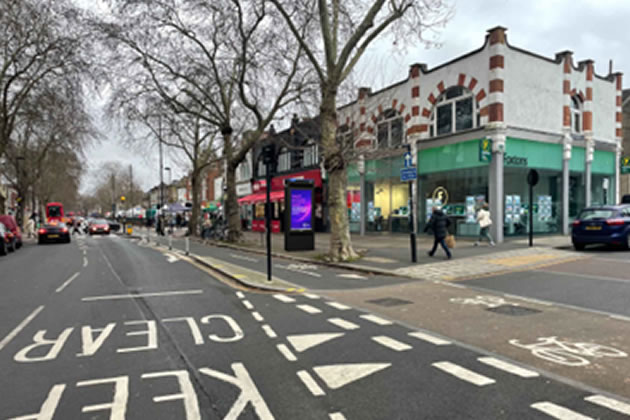
A visualisation of the Street Hub proposed by Foxtons from planning documentation
Earlier applications for similar proposals for a different set of phone boxes not owned by BT, which were refused in 2024 and lost on appeal in May 2025, involved a different operator. Those applications were submitted by NWP Street Limited, a company majority-owned by Clear Channel, the outdoor advertising company. NWP owned certain kiosks on the High Road — specifically those near the Empire House development at 414 Chiswick High Road and at 116 Chiswick High Road near the Sainsbury's Local. NWP's 2024 applications sought to replace its own ageing nineties-era kiosks with new units incorporating digital advertising and defibrillators. The scheme would also have resulted in the complete removal of two NWP boxes outside Planet Organic at 199 Chiswick High Road and a box at 24 Turnham Green Terrace.
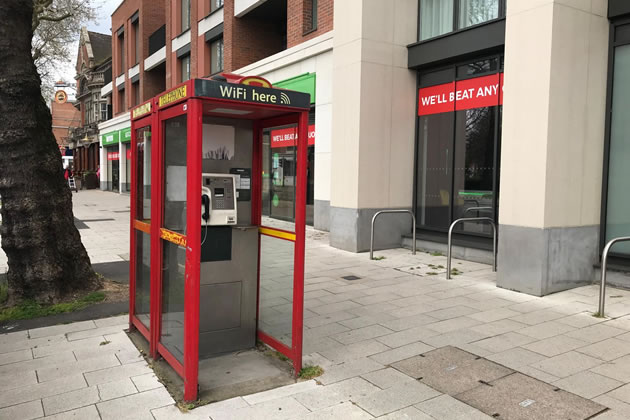
The phone box outside Empire House
The refusal of the NWP applications in late 2024 and the dismissal of NWP's advertising appeal in May 2025 were rooted primarily in the effect of illuminated digital displays on the Turnham Green Conservation Area. The Planning Inspector's appeal decision was emphatic. He found that the character of Chiswick High Road, while busy, retained a degree of visual restraint, and that the existing illuminated advertising in the vicinity — including the free-standing digital unit he noted near the appeal site — should not be treated as a benchmark for further replication. He concluded that the advertising scheme would be "unduly detrimental to amenity" and dismissed the appeal.
If Hounslow Council were to grant advertisement consent to any of the BT Street Hub applications, it would potentially create a precedent that would see a renewed an attempt to replace the remaining non-BT units. The NWP planning statement for the 414 High Road application had already argued that a digital advertising board approved closer to the Old Packhorse pub meant illuminated advertising was "no longer incongruous within the Conservation Area." The Inspector rejected that line of argument, but a fresh approval for BT's hubs — which feature broadly similar double-sided illuminated digital displays — would significantly strengthen NWP's hand in any future application or renewed appeal.
There is some basis for distinguishing the cases — the BT sites at 382, 223-225 and 137 are further from the most sensitive viewpoints across Turnham Green than the NWP site at 408-414 — but the principle of illuminated digital advertising on the High Road within the Conservation Area is the same. A grant for BT would almost certainly be used by NWP in any future submission as direct evidence of a change in planning circumstances.
BT's planning statements give details of the financial model behind the Street Hubs. The predecessor product, the InLink unit launched in 2017, was explicitly funded by the HD advertising displays on its sides. When the InLink supplier went into administration in 2019, BT developed the Street Hub as a replacement. The statement is careful not to quantify what proportion of a Street Hub's operating revenue comes from advertising, but the commercial logic is not difficult to follow: free Wi-Fi, free calls, free defibrillator access and environmental monitoring sensors do not pay for themselves. The advertising panels are the revenue mechanism.
This is underscored by the way the applications are structured. Every Street Hub application is paired with a separate advertising consent application. The two are legally distinct — a planning permission for the structure can be granted without the advertising consent, as the Hounslow delegated report for the NWP application at 408-414 demonstrated, when it recommended approving the kiosk structure but refusing the advertisement consent. The planning officer in that case found that the kiosk itself was acceptable but that the illuminated display was not. The Inspector on appeal agreed: he noted that if the implication of the advertising being refused was that the illuminated display was required to bring the hub forward commercially at that location, he was "not persuaded on over-arching merits of the change."
The Street Hub planning statement argues the proposal represents a public benefit in terms of connectivity, defibrillator provision, air quality monitoring and wayfinding. But the commercial viability of the entire project — and therefore whether the hubs actually get installed — probably depends on the advertising consent.
Lobby groups and heritage organisations have consistently pushed back against the wholesale removal of traditional phone provision. Advocacy around phone box retention in recent years has focused on several arguments. First, that public phones retain genuine safety value for people in distress, those whose mobile battery has failed, victims of domestic violence, and homeless individuals, many of whom rely on payphones as a primary means of communication. Second, that in an era of growing concern about digital exclusion, removing physical telecommunications infrastructure from the street without replacing it with something equally accessible risks marginalising vulnerable groups.
The NWP applicant's own design statement for the 2024 Chiswick applications criticised modern kiosks from BT and JC Decaux as failing to be instantly recognisable as telephone boxes. NWP argued its own replacement kiosks were designed to echo the visual language of traditional boxes. The BT Street Hub, by contrast, is a sleek vertical slab with a touchscreen interface and advertising panels; it bears no visual resemblance to a phone box at all.
The Street Hub does provide free calls — made openly on a speaker in the street, without the privacy of an enclosed box as well as a 999 emergency button. But it does not provide the enclosed, weather-protected, recognisable space that traditional boxes offered, and it would not necessarily be identified by a distressed or disoriented person as a source of help.
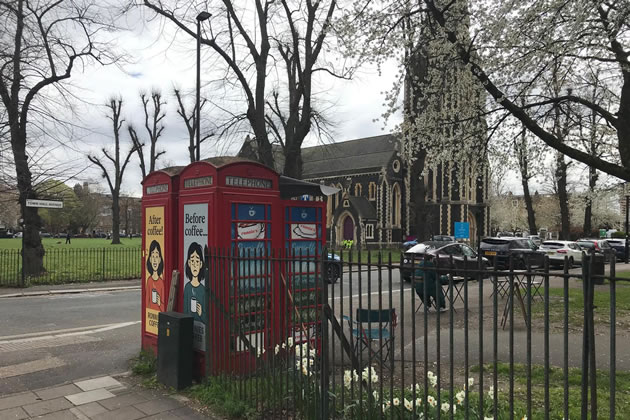
The traditional red phone boxes on Town Hall Avenue have been converted for use by a coffee stall
Two K6-style traditional red boxes remain near the Town Hall Avenue junction have been taken over for use by a coffee stall and are no longer connected. It may be that these heritage phone boxes, either working or not working, will eventually be the last remaining on Chiswick High Road.
You can comment on any of BT's current applications by visiting the planning section of the Hounslow Council web site and searching using the references given above.
Like Reading Articles Like This? Help Us Produce More This site remains committed to providing local community news and public interest journalism. Articles such as the one above are integral to what we do. We aim to feature as much as possible on local societies, charities based in the area, fundraising efforts by residents, community-based initiatives and even helping people find missing pets. We’ve always done that and won’t be changing, in fact we’d like to do more. However, the readership that these stories generates is often below that needed to cover the cost of producing them. Our financial resources are limited and the local media environment is intensely competitive so there is a constraint on what we can do. We are therefore asking our readers to consider offering financial support to these efforts. Any money given will help support community and public interest news and the expansion of our coverage in this area. A suggested monthly payment is £8 but we would be grateful for any amount for instance if you think this site offers the equivalent value of a subscription to a daily printed newspaper you may wish to consider £20 per month. If neither of these amounts is suitable for you then contact info@neighbournet.com and we can set up an alternative. All payments are made through a secure web site. One-off donations are also appreciated. Choose The Amount You Wish To Contribute. If you do support us in this way we’d be interested to hear what kind of articles you would like to see more of on the site – send your suggestions to the editor. For businesses we offer the chance to be a corporate sponsor of community content on the site. For £30 plus VAT per month you will be the designated sponsor of at least one article a month with your logo appearing if supplied. If there is a specific community group or initiative you’d like to support we can make sure your sponsorship is featured on related content for a one off payment of £50 plus VAT. All payments are made through a secure web site. |