Planners Block Chiswick Rooftop Extension Schemes
Proposals at Oxbridge Court and Claremont Grove denied permission
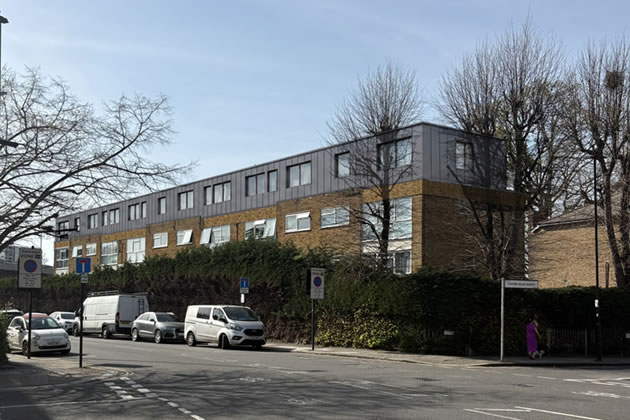
A visualisation of the planned height increase at Oxbridge Court seen from Wellesley Road. Picture: Stefan Shaw Studio
July 29, 2026
Hounslow Council planning officers have recently refused two proposals to add new flats on top of existing residential block in Chiswick.
The reasons give for the decision to not grant approval for the plan for Oxbridge Court, at the junction of Oxford Road North and Wellesley Road closely mirrored in the argument given by borough planners when rejecting a similar scheme at Claremont Grove near Dukes Meadows. The refusal, for Oxbridge Court on Oxford Road North, highlights growing scrutiny of “airspace” developments in conservation areas and appears to signal a tougher stance on rooftop intensification in the Chiswick area.
The Oxbridge Court application (ref. P/2026/1694) was submitted by developer Vera Road Limited, with designs prepared by Stefan Shaw Studio. The scheme sought permission to add a fourth storey to the 1970s block, creating six self-contained flats—three one-bed single-person units, one one-bed two-person unit, and two two-bed three-person apartments. Each new home would have been dual-aspect, with private roof terraces facing the internal courtyard and away from the M4 flyover.
The architects argued that the building’s flat roofline was “architecturally unresolved” and that a sensitively designed rooftop addition—set back from the parapet and clad in standing-seam metal panels—would improve the block’s appearance within the Wellesley Road Conservation Area. They pointed to the approved rooftop extension at Gillian Court on Cambridge Road North as a precedent for similar development.
But the council’s delegated report, published this week, reaches a different conclusion.
The report states that the proposed roof terraces would cause “unacceptable overlooking” of neighbouring gardens on Oxford Road North and Cambridge Road North, resulting in a harmful loss of privacy. The balconies, officers note, fail to comply with Local Plan policies requiring careful orientation to avoid direct views into nearby homes.
The design itself was also found to be inappropriate for the conservation area. The new storey, officers wrote, would be “an overly dominant and unsympathetic addition”, with an incongruous material palette and no meaningful setback. The extension would be highly visible from Wellesley Road and would neither preserve nor enhance the significance of the conservation area.
Parking and transport formed the third reason for refusal. Despite the scheme being presented as car-free, officers said the applicant had provided no car park occupancy survey, leaving the council unable to assess whether additional demand could be absorbed on-site. The proposed cycle parking was also judged inadequate, with insufficient space to accommodate the stands without obstructing access.
Finally, the council found that the proposal failed to meet required energy-efficiency standards. The scheme did not incorporate expected “fabric-first” measures such as triple-glazed windows, and the submitted energy figures contained discrepancies that were not explained.
The Oxbridge Court decision follows the council’s refusal of a larger rooftop extension at Claremont Grove, where developers sought prior approval to add 18 new flats across two additional storeys. That scheme was rejected on grounds of excessive height, design harm and the absence of a parking stress survey.
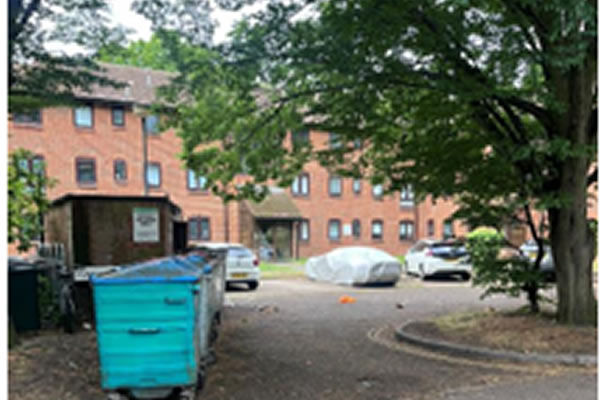
Permission was being sought to increase the building height by two storeys at Claremont Grove
A third application—at Grandfield Court (ref. P/2026/1969)—remains under consideration. Residents of the 18 occupied flats submitted objections, and ward councillors have already asked that the scheme be referred to the Planning Committee rather than decided under delegated powers.
Objections highlight long-standing drainage problems in the building, yet say that the application contains no drainage strategy for adding five new kitchens and bathrooms above them. The applicant’s own daylight report shows two existing top-floor kitchens losing between a quarter and a third of their daylit area, a finding set aside by classifying the rooms as “non-habitable.”
Airspace schemes have been promoted nationally as a way to deliver new homes without consuming additional land. But in Chiswick, where conservation areas, constrained sites and close-knit residential streets dominate, the council’s recent decisions show a clear emphasis on design quality and neighbour impact.
Both the Claremont Grove and Oxbridge Court decisions may still be appealed to the Planning Inspectorate.
Like Reading Articles Like This? Help Us Produce More This site remains committed to providing local community news and public interest journalism. Articles such as the one above are integral to what we do. We aim to feature as much as possible on local societies, charities based in the area, fundraising efforts by residents, community-based initiatives and even helping people find missing pets. We’ve always done that and won’t be changing, in fact we’d like to do more. However, the readership that these stories generates is often below that needed to cover the cost of producing them. Our financial resources are limited and the local media environment is intensely competitive so there is a constraint on what we can do. We are therefore asking our readers to consider offering financial support to these efforts. Any money given will help support community and public interest news and the expansion of our coverage in this area. A suggested monthly payment is £8 but we would be grateful for any amount for instance if you think this site offers the equivalent value of a subscription to a daily printed newspaper you may wish to consider £20 per month. If neither of these amounts is suitable for you then contact info@neighbournet.com and we can set up an alternative. All payments are made through a secure web site. One-off donations are also appreciated. Choose The Amount You Wish To Contribute. If you do support us in this way we’d be interested to hear what kind of articles you would like to see more of on the site – send your suggestions to the editor. For businesses we offer the chance to be a corporate sponsor of community content on the site. For £30 plus VAT per month you will be the designated sponsor of at least one article a month with your logo appearing if supplied. If there is a specific community group or initiative you’d like to support we can make sure your sponsorship is featured on related content for a one off payment of £50 plus VAT. All payments are made through a secure web site. |