Judge Quashes Planning Approval for Burlington Lane Tower
Rules that report presented to councillors was misleading
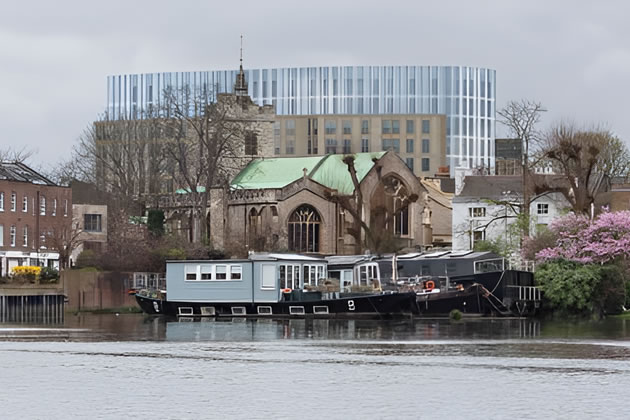
A visualisation from planning documents of how the building would look behind St. Nicholas Church
September 15, 2026
A High Court judge has overturned Hounslow Council's decision to approve a controversial ten-storey development at the Hogarth Roundabout, ruling that councillors were given a misleading picture of an alternative, smaller scheme before they voted.
The judgment, handed down this Monday (14 September), is a huge win for the Old Chiswick Protection Society (OCPS), the local heritage group that brought the legal challenge after the 130-flat scheme was waved through by the council's planning committee in August 2025.
The site at 1 Burlington Lane already has planning permission for a smaller, five-storey conversion — a scheme that was originally rejected by Hounslow but later approved on appeal by a government planning inspector in 2024. Because that older scheme could be built regardless of what happened with the new application, it acted as a "fallback": something councillors were entitled to weigh up when deciding whether the bigger, taller building was worth the harm it would do to nearby historic sites, including St Nicholas' Church and Chiswick House.
The problem, the judge found, was in how council planning officers described that fallback scheme to councillors. Their report — and a presentation given at the meeting — repeatedly told councillors the smaller scheme offered a poor standard of accommodation and poor-quality design. But the planning inspector who had approved that very scheme the year before had said the opposite: that it involved high-quality design and acceptable living conditions. In other words, council officers were effectively telling councillors that a scheme was substandard, when a government inspector had specifically already found it wasn't.
The developer and the council both argued that even if the written report was flawed, things were put right during the meeting itself. Russell Harris KC, president of the OCPS, spoke against the scheme and pointed out that the inspector had rejected the council's criticisms. But the judge found this wasn't enough to fix the problem — partly because Harris was speaking as an objector rather than a neutral voice, and partly because council officers corrected other errors raised during the meeting (such as a missing objection from Richmond Council) but stayed silent on this point, giving the impression his comments on the fallback scheme's quality weren't valid.
Legal advice given to councillors near the end of the meeting also fell short, the judge said, because it told them they didn't need to go into the detail of what the inspector had actually decided — when understanding that detail was exactly what they needed to fairly compare the two schemes.
Because councillors were left thinking they were choosing between a "good" new scheme and a "bad" old one, rather than comparing a new scheme against an old one that had already been found perfectly acceptable, the judge ruled the whole comparison — and the decision that flowed from it — was unsound.
The council and developer had argued that even if there was an error, the outcome would "highly likely" have been the same regardless, given the extra homes, affordable housing and other benefits the new scheme offered. The judge rejected this, saying the fallback scheme's quality was too central to the planning balance for the court to be confident the decision wouldn't have been different with accurate information.
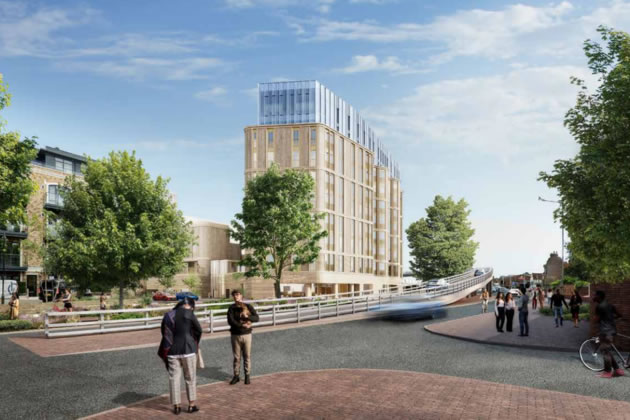 CGI of scheme as viewed from Burlington Lane. Picture: Simpson Haugh Architects
The result is that Hounslow's original decision to grant planning permission has been quashed. The application will need to go back to the council's planning committee to be considered again — this time with councillors properly informed about what the planning inspector actually concluded about the smaller scheme, and why. The developer, Burlington Properties London Limited, will need to wait for that fresh decision before the taller scheme can proceed.
The judge stressed that the case was about the standard of information given to a decision-making committee, not about whether tall buildings are appropriate for the site in principle.
OCPS Chair Graham Clifton said, “We did not embark on litigation lightly. We are delighted with the outcome. It’s a resounding victory for OCPS. The judge agreed that the legal advice to the London Borough of Hounslow’s Planning Committee on 20th January 2026 was wrong. The decision which followed was unlawful. A Planning Committee cannot simply ignore the conclusions of the Planning Inspector who ruled that an earlier scheme of six storeys was acceptable and of good quality design.”
"At the LBH Planning Committee public meeting, OCPS repeatedly stated that the process was incorrect. Had LBH listened then, we would have avoided this litigation, which has been hugely costly for both Hounslow taxpayers and the very generous supporters of OCPS."
He stressed that this may not be the end of the story and that the application is likely to go back to the Planning Committee and urged opponents not to let up campaigning against it.
Like Reading Articles Like This? Help Us Produce More This site remains committed to providing local community news and public interest journalism. Articles such as the one above are integral to what we do. We aim to feature as much as possible on local societies, charities based in the area, fundraising efforts by residents, community-based initiatives and even helping people find missing pets. We’ve always done that and won’t be changing, in fact we’d like to do more. However, the readership that these stories generates is often below that needed to cover the cost of producing them. Our financial resources are limited and the local media environment is intensely competitive so there is a constraint on what we can do. We are therefore asking our readers to consider offering financial support to these efforts. Any money given will help support community and public interest news and the expansion of our coverage in this area. A suggested monthly payment is £8 but we would be grateful for any amount for instance if you think this site offers the equivalent value of a subscription to a daily printed newspaper you may wish to consider £20 per month. If neither of these amounts is suitable for you then contact info@neighbournet.com and we can set up an alternative. All payments are made through a secure web site. One-off donations are also appreciated. Choose The Amount You Wish To Contribute. If you do support us in this way we’d be interested to hear what kind of articles you would like to see more of on the site – send your suggestions to the editor. For businesses we offer the chance to be a corporate sponsor of community content on the site. For £30 plus VAT per month you will be the designated sponsor of at least one article a month with your logo appearing if supplied. If there is a specific community group or initiative you’d like to support we can make sure your sponsorship is featured on related content for a one off payment of £50 plus VAT. All payments are made through a secure web site. |