Chiswick-led Campaign for EV Gully Charging Gains Momentum
Growing support for alternative to unreliable lamppost chargers
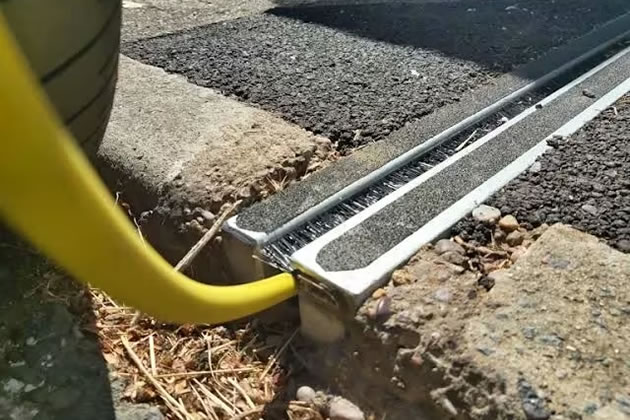
Some councils across the country already allow cross pavement charging with others looking into the option
August 9, 2026
A Chiswick-led campaign is calling on Hounslow Council to rethink its position on cross-pavement electric vehicle (EV) charging, arguing that current policies leave many residents unable to charge their cars affordably or reliably.
A number of councillors have responded positively to pleas from residents to look at the issue and recently a petition has been launched by a Grove Park resident.
Chiswick has an unusual combination of a high proportion of EV ownership combined with a very low rate of homes with their own driveways meaning that most are unable to use their domestic electricity supply to charge. Instead, they rely on lamppost charging — a system that residents say is both expensive and increasingly unreliable. Several EV owners have reported persistent faults with Shell-operated lamppost chargers, including units that fail to activate or deliver charge. Some drivers say they have been forced to travel significant distances to find working chargers, while others have resorted to using more costly Source London units near Kew Bridge.
The petition argues that the solution lies in allowing pavement gullies: narrow channels set into the footway that enable residents to run a charging cable safely from their home to their vehicle without obstructing pedestrians. The technology is already in use elsewhere in the UK, and campaigners say Hounslow is falling behind.
The petition states: “In the era of climate change and the global effort to transition towards green energy, electric vehicles have become a cornerstone of sustainable transportation. However, for residents in Hounslow, the practicalities of owning an EV are hindered by the lack of accessible home charging solutions.”
It highlights the growing demand for EVs — more than 20,000 registered in London alone — and the looming 2030 phase-out of petrol and diesel cars. For households without driveways, the petition argues, the inability to charge at home represents both a practical barrier and an unfair financial burden. Charging an EV overnight on a home tariff costs around £4–£6 for roughly 330 miles of range. The same charge at a public point can cost around £32. Over a year, even at one charge per month, that amounts to an additional £320 — roughly a third of a typical family’s annual electricity bill.
Campaigners also challenge the council’s previous reasoning for rejecting gullies, pointing to national trends. Of 134 councils responding to a recent FOI request, seven already permit gullies, 21 are trialling them, and 28 plan to introduce them in 2026. National legislation is expected to make gullies permitted development, though the timing remains unclear.
Cllrs Amy Croft and Salman Shaheen have both backed the call for change and have asked officers to explore how gully charging could be safely implemented. Cllr Rick Rowe said he was pleased the issue was being examined and supported solutions that would allow residents without driveways to charge from home.
Hounslow Council has acknowledged the growing interest in EV charging and confirming that a review is under way. While the borough does not currently permit cable gullies, officers are “carrying out a thorough, proactive review” to explore whether they can be integrated safely in future.
The council says its considerations centre on community safety, fairness and accessibility, and long-term maintenance. It emphasises concerns about trailing cables, shared pavements, and the need to keep kerbs accessible for all residents, including those with mobility or visual impairments.
In the meantime, Hounslow is focusing on expanding its public charging network, with an ambition to ensure that every resident without a driveway is “never more than a 30-second walk from a dedicated public charger.”
The debate echoes similar tensions in neighbouring boroughs. Last year, Ealing Council confirmed it would not proceed with a gully trial, despite 75% of respondents to its own EV survey supporting the idea. Critics accused Ealing of ignoring public opinion and missing out on government funding, while pointing to trials in Richmond, Brent, Enfield and Nottinghamshire. Ealing defended its decision on safety grounds and said it would continue to monitor national evidence.
argue that without access to home charging, EV adoption will stall — not because residents oppose change, but because the infrastructure does not yet support them.
The petition urges Hounslow to act: “We need your support. By signing this petition, you can help make home charging of EVs accessible for everyone in Hounslow, promoting a cleaner and more sustainable future for our community.”
The petition can be found here.
Like Reading Articles Like This? Help Us Produce More This site remains committed to providing local community news and public interest journalism. Articles such as the one above are integral to what we do. We aim to feature as much as possible on local societies, charities based in the area, fundraising efforts by residents, community-based initiatives and even helping people find missing pets. We’ve always done that and won’t be changing, in fact we’d like to do more. However, the readership that these stories generates is often below that needed to cover the cost of producing them. Our financial resources are limited and the local media environment is intensely competitive so there is a constraint on what we can do. We are therefore asking our readers to consider offering financial support to these efforts. Any money given will help support community and public interest news and the expansion of our coverage in this area. A suggested monthly payment is £8 but we would be grateful for any amount for instance if you think this site offers the equivalent value of a subscription to a daily printed newspaper you may wish to consider £20 per month. If neither of these amounts is suitable for you then contact info@neighbournet.com and we can set up an alternative. All payments are made through a secure web site. One-off donations are also appreciated. Choose The Amount You Wish To Contribute. If you do support us in this way we’d be interested to hear what kind of articles you would like to see more of on the site – send your suggestions to the editor. For businesses we offer the chance to be a corporate sponsor of community content on the site. For £30 plus VAT per month you will be the designated sponsor of at least one article a month with your logo appearing if supplied. If there is a specific community group or initiative you’d like to support we can make sure your sponsorship is featured on related content for a one off payment of £50 plus VAT. All payments are made through a secure web site. |